



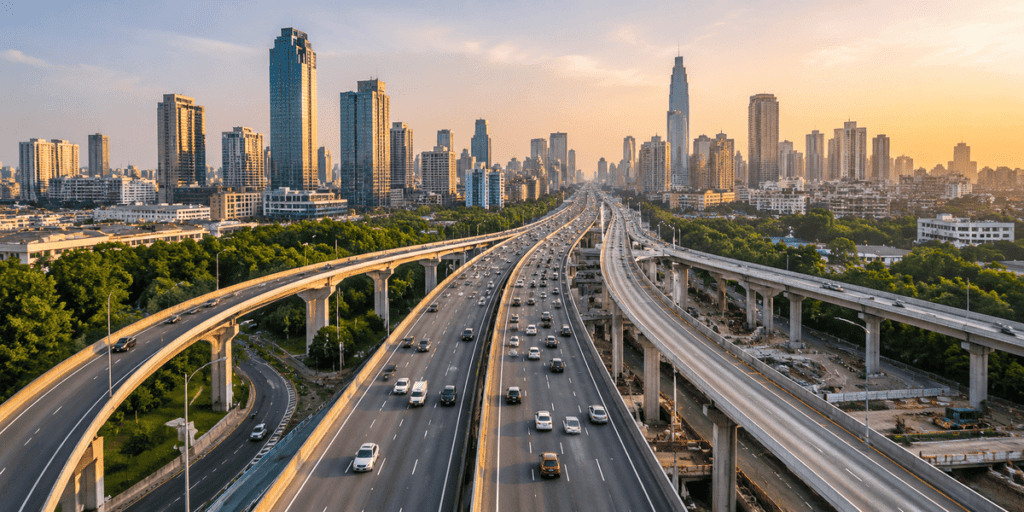
Urban areas around the world are growing at a pace that infrastructure can barely keep up with. As populations surge and traffic volumes climb, the demand for expanded and modernized highway networks has never been higher. Yet the path to building new urban highways or upgrading existing ones is riddled with complex, costly, and often controversial obstacles. Understanding the urban highway development challenges today is essential for policymakers, urban planners, engineers, and communities alike.
This article explores the most pressing challenges shaping urban highway development in the modern era and what forward-thinking cities are doing to address them.
Table of Contents
ToggleSkyrocketing Costs and Funding Gaps
One of the most significant urban highway development challenges today is the sheer financial burden these projects carry. Urban highway construction costs have risen dramatically over the past two decades, driven by inflation in construction materials, labor shortages, and the complexity of building in densely populated environments.
In major metropolitan areas, tunneling, elevated structures, and utility relocation alone can push per-mile costs into the hundreds of millions of dollars. Public funding through federal and state budgets is often insufficient to cover these needs, leading cities to explore public-private partnerships (PPPs), toll financing, and municipal bonds.
However, reliance on toll revenue creates its own equity concerns placing a disproportionate financial burden on lower-income commuters who depend on these routes. Finding a sustainable, equitable funding model remains one of the defining urban highway development challenges today.
Environmental Impact and Sustainability Pressures
Modern urban highway development cannot proceed without confronting serious environmental challenges. The construction and operation of highways contribute to air pollution, greenhouse gas emissions, stormwater runoff, urban heat island effects, and habitat fragmentation.
Stricter environmental regulations including environmental impact assessments (EIAs), emissions standards, and biodiversity protections have extended project timelines and increased compliance costs significantly.
At the same time, cities face mounting pressure from climate commitments to reduce car dependency altogether. This creates a genuine tension: how do you build highway infrastructure that accommodates today’s vehicle traffic while also progressing toward a greener, lower-emission urban future?
Some cities are responding with green highway design principles incorporating noise barriers with solar panels, permeable pavements, wildlife crossings, and integrated green corridors. But retrofitting sustainable design into large-scale infrastructure remains technically and financially demanding.
Community Displacement and Social Equity Concerns
History has shown that urban highways often cut through the most vulnerable neighborhoods. The legacy of mid-20th century urban renewal projects which demolished entire communities in the name of “progress” has left deep scars that contemporary planners must acknowledge and actively work to avoid repeating.
Today, social equity is central to the conversation around urban highway development challenges. Residents in the path of proposed highway expansions or new routes face displacement, loss of cultural identity, noise pollution, and reduced property values all while bearing little of the economic benefit.
Community opposition to highway projects has grown louder and more organized. Planners must now conduct genuine stakeholder engagement, not just checkbox consultation. This includes multilingual outreach, participatory design processes, and legally binding community benefit agreements (CBAs) that ensure displaced residents receive fair relocation assistance and that local jobs are prioritized.
Land Scarcity and Urban Density
Finding room to build in established urban environments is one of the most physically daunting of all urban highway development challenges today. Unlike greenfield suburban development, urban highway projects must navigate a dense patchwork of existing buildings, underground utilities, metro lines, pipelines, and public spaces.
Every meter of right-of-way (ROW) acquisition involves complex legal negotiations, eminent domain proceedings, and expensive buyouts. In cities like Tokyo, Singapore, and New York, underground highway solutions have become more common but tunneling dramatically increases costs and introduces engineering risks such as groundwater management and subsidence.
The spatial constraints of urban environments also limit what can be built above ground. Elevated highways, once seen as bold solutions, are increasingly being torn down (as seen in San Francisco’s Embarcadero Freeway and Seoul’s Cheonggyecheon restoration) due to their negative impact on neighborhoods. This leaves planners in a difficult position: there is rarely a clean, easy route available.
Aging Infrastructure and Maintenance Backlogs
A significant but often underreported urban highway development challenge is the deteriorating condition of existing infrastructure. Across the United States, Europe, and other regions, a large share of highway bridges, overpasses, and road surfaces were built in the mid-20th century and are now well past their original design life.
The American Society of Civil Engineers (ASCE) has repeatedly given U.S. infrastructure poor grades, estimating that tens of thousands of bridges are structurally deficient. In urban areas, deferred maintenance on existing highways competes directly with funding for new construction.
Cities must make hard choices: invest in expensive greenfield highway projects, or prioritize the repair and modernization of what already exists? For many municipalities, the answer is increasingly the latter particularly as “fix it first” policies gain political traction. However, maintenance projects often lack the visibility of new construction, making them harder to fund through traditional public financing mechanisms.
Technological Disruption and Future-Proofing
Urban highway development today must account for a rapidly changing technological landscape. The rise of electric vehicles (EVs), autonomous vehicles (AVs), ride-sharing platforms, and smart traffic management systems is already reshaping how highways are used and will continue to do so at an accelerating pace.
Building a highway with a 50–100 year design life means planning for technologies that don’t yet exist at scale. Designers must consider EV charging infrastructure integration, dedicated AV lanes, sensor-embedded pavement, dynamic tolling systems, and data connectivity infrastructure.
Failure to future-proof highway investments risks building infrastructure that becomes obsolete long before it reaches the end of its structural life, a costly and politically damaging outcome.
Regulatory Complexity and Prolonged Approval Timelines
Navigating the regulatory environment is another of the critical urban highway development challenges today. Major projects typically require approvals from multiple overlapping jurisdictions federal, state/provincial, and municipal, each with its own environmental, safety, and land-use regulations.
In the United States, the National Environmental Policy Act (NEPA) process alone can take years, with some major highway projects spending a decade or more in planning, review, and legal challenge phases before a single shovel hits the ground. Legal challenges from environmental groups, affected residents, or competing interest groups can add years to timelines.
While regulatory processes exist for legitimate reasons protecting communities and the environment, excessive fragmentation and duplication of review processes contribute to cost overruns and prolonged uncertainty for all stakeholders. Streamlining these processes without sacrificing protections is a challenge that governments worldwide are actively trying to address.
Moving Forward: Integrated Urban Highway Planning
Addressing these urban highway development challenges today requires a shift in approach from siloed engineering projects to integrated, community-centered urban mobility planning. The most successful cities are those that:
Align highway development with broader transit, cycling, and pedestrian strategies
Engage communities early and meaningfully in the planning process
Adopt life-cycle cost analysis rather than focusing only on upfront construction costs
Invest in digital modeling and smart infrastructure to maximize efficiency
Commit to transparent, equitable funding mechanisms
Urban highways are not inherently a relic of the past but the way we build them must evolve significantly to meet the demands of the 21st century city.
Frequently Asked Questions
Q1: What are the biggest urban highway development challenges today?
The biggest urban highway development challenges today include funding gaps, environmental sustainability pressures, community displacement, land scarcity in dense urban areas, aging existing infrastructure, technological disruption, and complex regulatory approval processes. Each of these challenges requires tailored solutions and cross-sector collaboration.
Q2: Why does urban highway construction cost so much more than rural highway construction?
Urban highway construction is significantly more expensive due to land acquisition costs, the need to work around existing underground utilities and transit systems, higher labor costs in cities, and the complexity of minimizing disruption to surrounding communities during construction. Tunneling and elevated structures also add substantially to project budgets.
Q3: How are cities balancing highway development with environmental commitments?
Many cities are incorporating green design features such as permeable surfaces, solar-integrated noise barriers, wildlife crossings, and urban tree canopies into highway projects. Some are also prioritizing transit and active transportation investments alongside or instead of highway expansion to reduce overall vehicle emissions.
Q4: What is a community benefit agreement (CBA) in highway development?
A Community Benefit Agreement (CBA) is a legally binding contract between a developer or public agency and a community coalition. In the context of highway development, CBAs typically guarantee local hiring, affordable housing for displaced residents, green space creation, and ongoing community oversight ensuring that affected neighborhoods share in the project’s benefits.
Q5: How can cities future-proof highway infrastructure for autonomous and electric vehicles?
Cities can future-proof highways by designing flexible infrastructure that can accommodate embedded sensors, EV charging stations, dedicated AV lanes, and smart tolling systems. Modular design approaches and digital twin modeling also help planners simulate how infrastructure will perform under different future scenarios before committing to construction.