


Pakistan’s roads are among the most dangerous in Asia. In 2021 alone, over 10,379 road accidents were recorded, resulting in 5,608 fatalities.
A former Minister of Communications stated that a person is killed or seriously injured in a road accident in Pakistan every five minutes. That number is sobering, and it does not fully account for the thousands of accidents that go unreported every year.
A significant portion of these accidents happens at night. The reason is straightforward. Darkness removes the most fundamental tool a driver has the ability to see clearly. Speed limits, turn warnings, pedestrian crossings, lane markings, and sharp curves all of this critical information becomes invisible when the road is not properly lit, and signs do not reflect light back to the driver’s eyes.
Reflective road signs are not a luxury. They are a frontline safety measure that sits between a driver making a safe decision and a fatal crash.
So let us help you know, why reflective road signs are critical for nighttime driver safety in Pakistan, what they do, how they work, where they matter most, and what the cost of poor signage looks like in real terms.
Table of Contents
ToggleThe Nighttime Driving Problem in Pakistan
Nighttime driving is inherently more dangerous than daytime driving for every driver in every country. The challenge is more severe on Pakistan’s roads because many national and provincial highways have little to no street lighting.
A driver on the GT Road between cities, on rural roads in Punjab or Sindh, or on mountain highways in KPK is frequently navigating in near-complete darkness relying entirely on headlights and roadside signs to understand what lies ahead.
Global research shows that roughly 50% of all traffic fatalities occur at night despite only 25% of total driving happening during those hours. That disproportionate death rate is not a coincidence. Reduced visibility, driver fatigue, and the greater distances at which information needs to be visible all combine to make nighttime driving significantly more dangerous.
For Pakistan specifically, the problem is compounded. Many roads lack proper markings, signs, and safety features, creating dangerous conditions, especially after dark. Pedestrians make up 41% of road fatalities in Pakistan, higher than the Asia-Pacific average of 31%.
A large share of those deaths happens because drivers simply could not see pedestrians or the signs that would have told them to slow down and watch for crossing traffic until it was too late.
Reflective road signs are the single most practical and cost-effective infrastructure intervention available to address this visibility gap.
What Are Reflective Road Signs?
Reflective road signs are traffic signs coated with retroreflective sheeting a specialised material engineered to send light from a vehicle’s headlights directly back toward the driver’s eyes. The result is a sign that appears to glow brightly in the dark, visible from hundreds of metres away, while the surrounding environment stays dark and unlit.
The technology works through two mechanisms: glass bead systems and microprismatic structures. Glass bead sheeting uses tiny transparent spheres embedded in the sign surface that refract and return light.
Microprismatic sheeting uses geometric cube-corner structures that reflect light far more efficiently capturing and returning a much higher percentage of incoming light directly toward the driver.
The critical distinction is that this is not passive reflection like a mirror. It is active retroreflection a directional light return specifically aimed at the person sitting behind the headlights. A standard white surface might scatter 5 to 8% of incoming light randomly.
A high-grade retroreflective sign returns the majority of that light precisely back toward the driver’s eyes. That difference is what makes a sign visible from 400 metres rather than 40 metres at night.
How Reflective Road Signs Extend a Driver’s Reaction Time
Speed and reaction time are inseparable in road safety. A vehicle travelling at 80 km/h covers over 22 metres every second. At 120 km/h on a motorway, that increases to 33 metres per second. The time between seeing a warning sign and completing a safe response, slowing down, adjusting lane position, and preparing for a turn, is measured in seconds. Those seconds are only available if the sign becomes visible far enough in advance.
A standard non-reflective or low-grade sign might become visible to a driver at 50 to 80 metres at night.
Diamond Grade retroreflective sheeting makes the same sign visible from 400 to 500 metres or more.
At 80 km/h, that difference gives a driver an additional 15 seconds of decision time. On a sharp curve, a narrow bridge approach, or a pedestrian crossing on a rural highway, those 15 seconds are the difference between a safe stop and a fatal crash.
High-quality reflective road signs also help drivers read and process information more quickly. Brighter, more visible signs reduce the cognitive effort required to identify and interpret what a sign says, which matters especially for older drivers and for anyone navigating an unfamiliar route in the dark.
Where Reflective Road Signs Matter Most in Pakistan
Rural and Inter-City Highways
Pakistan’s national highway network spans approximately 262,256 kilometres. The vast majority of rural and inter-city highway stretches have no street lighting at all. On these roads, reflective signs are not supplementary safety features — they are the only source of roadside visual information available to drivers at night.
Warning signs on these roads include curve warnings, speed limit signs, intersection markers, and bridge approach signs. These must be clearly visible from a safe stopping distance to serve their purpose. A sign that can only be seen from 50 metres on an 80 km/h highway is functionally useless. By the time a driver sees it, there is no safe stopping distance remaining.
Upgrading reflective road signs on inter-city highways to high-performance retroreflective sheeting is one of the most direct infrastructure investments available for reducing nighttime fatalities on Pakistan’s national road network.
Sharp Curves and Mountain Roads
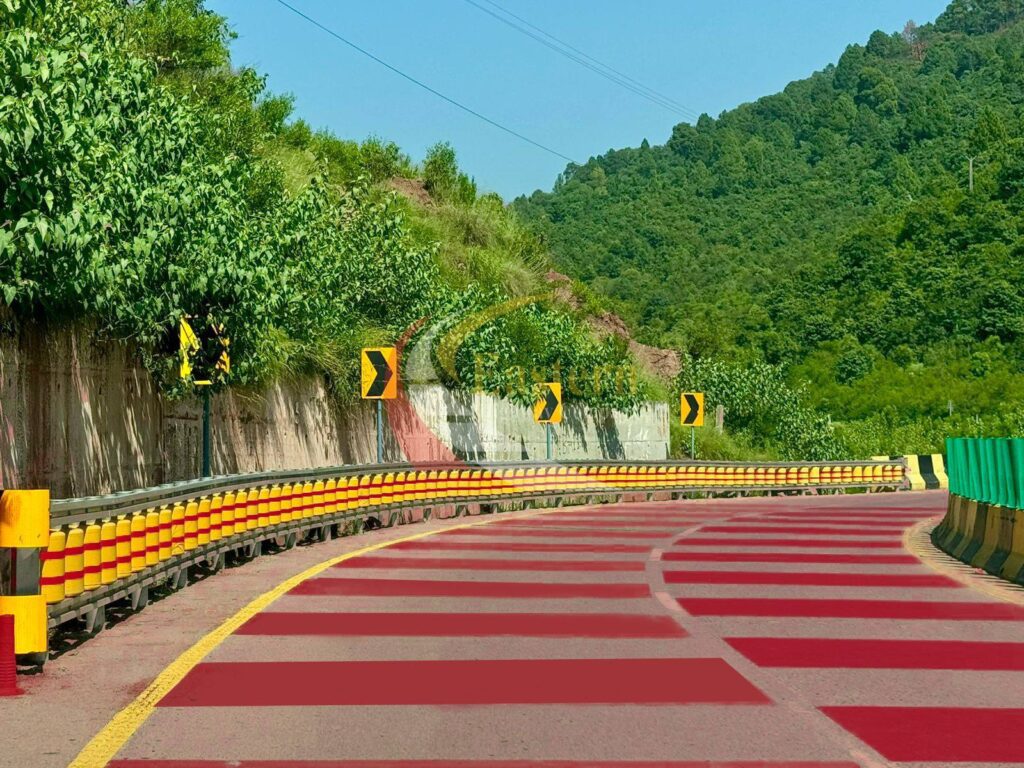
Curved roads are where the visibility problem becomes genuinely deadly. Research shows that fatal crashes on curves are three to four times more likely to occur at night than during the day. Headlights illuminate only the direction the vehicle is currently pointed, not the curve ahead. By the time a curve enters the headlight beam, a driver at speed may have very little distance to slow down safely.
Retroreflective chevron signs and curve warning signs placed in advance of bends give drivers the information they need before the physical curve becomes visible. On Pakistan’s mountain highways in areas like Khyber Pakhtunkhwa, Azad Kashmir, and Balochistan, where curves are frequent and drops can be fatal, high-performance reflective signage is an urgent safety requirement.
Research confirms that fluorescent retroreflective sheeting at curves can reduce crashes at those locations by up to 18%. On Pakistan’s mountain road network, even a modest crash reduction of this scale represents dozens of lives saved annually.
Intersections and Crossroads
Intersections are among the most dangerous points on any road network. Conflicting traffic movements, pedestrian crossings, and the need to process multiple signs simultaneously create high cognitive demands on drivers demands that become significantly harder to meet in low light.
Every intersection on Pakistan’s road network, urban and rural alike, depends on reflective signage to communicate priority, speed limits, direction, and crossing warnings to approaching drivers.
A stop sign that cannot be seen from a safe stopping distance is not fulfilling its safety function. A yield sign that disappears into the dark background at night creates a false impression of an open road.
Pedestrian crossing signs at intersections and crosswalks are especially critical. Data shows that 76% of pedestrian fatalities occur at night. High-visibility reflective signs at crossing points are a direct countermeasure to this figure.
When pedestrian crossing warnings are clearly visible from a safe approach distance, drivers have the reaction time needed to slow down before reaching the crossing.
Construction and Road Work Zones
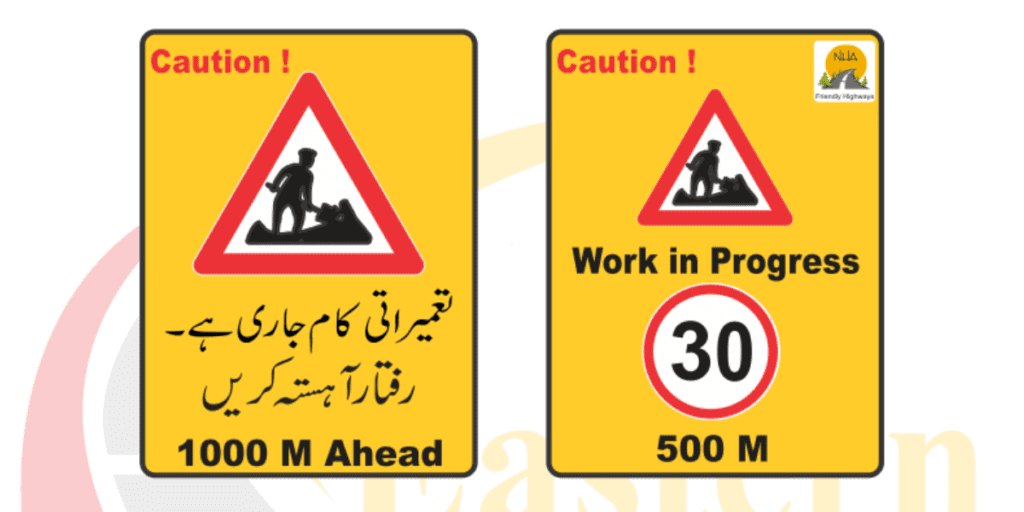
Pakistan’s rapidly expanding road infrastructure including CPEC-related projects and national highway upgrades means construction zones are a constant feature of the country’s road network.
Construction zones are among the most hazardous sections of any road. Lane configurations change, surfaces are uneven, speed reductions are required, and workers may be present at all hours.
Temporary reflective signs in construction zones need to be visible from the same distances as permanent highway signage, often under conditions where familiar road patterns have changed and drivers are already uncertain about what to expect.
Under-lit or non-reflective temporary signage in active construction zones directly increases the risk of high-speed crashes in areas where workers are present.
Urban Roads and City Streets
Pakistani cities like Karachi, Lahore, Islamabad, Peshawar, and Quetta have dense, complex road networks where signage must compete with ambient lighting, vehicle headlights, streetlamps, and commercial lighting.
Urban reflective road signs must perform under these competing light conditions, which require high-contrast, high-brightness retroreflective materials to remain readable.
Speed limit signs, no-entry signs, pedestrian crossing warnings, and directional signs in urban areas all depend on retroreflective performance to be legible and useful to approaching drivers, particularly on roads with higher speed limits where reaction time is limited.
Grades of Reflective Sheeting and Their Applications
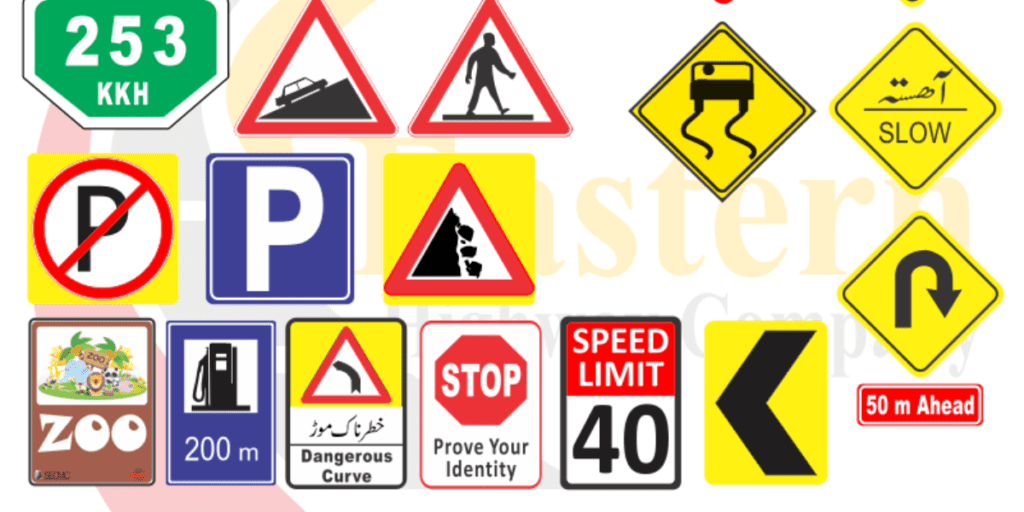
Not all reflective signs perform equally. The grade of retroreflective material used on a sign directly determines how far away it becomes visible and how well it maintains that visibility over time. Matching the correct grade to the road environment is essential for genuine safety benefits.
Engineer Grade
Engineer Grade sheeting uses glass bead technology and delivers the most basic level of retroreflectivity. It is suitable for low-speed residential streets, parking areas, and secondary signage in low-traffic locations. On roads with speed limits above 50 km/h, Engineer Grade sheeting does not provide sufficient visibility distance for drivers to react safely.
High-Intensity Prismatic Grade
High-Intensity Prismatic (HIP) sheeting uses microprismatic technology to deliver significantly greater brightness and a wider angle of visibility than Engineer Grade. It is appropriate for urban arterials, collector roads, and secondary highways where moderate speed limits and higher nighttime traffic volumes require greater sign brightness and detection distance.
Diamond Grade
Diamond Grade sheeting is the highest-performing retroreflective material available for traffic signs. It uses advanced full-cube microprismatic technology and reflects nearly twice the light of High-Intensity Prismatic sheeting. Diamond Grade signs are visible from 400 to 500 metres or more, giving drivers at highway speeds the full reaction time they need.
High-quality Diamond Grade sheeting has been shown to cut nighttime accidents by up to 46% compared to lower-grade alternatives. For Pakistan’s national highways, motorways, mountain roads, and any high-speed road environment, Diamond Grade is the correct and necessary specification.
What Happens When Reflective Signs Degrade
Retroreflective sheeting does not maintain peak performance permanently. UV exposure, temperature cycling between day and night, physical abrasion from dust and debris, and the effects of heavy rainfall all degrade the optical elements of the sheeting material over time.
The dangerous reality is that a sign can look perfectly acceptable during a daytime inspection while failing completely at night. The white or yellow surface may remain clean and readable in daylight. If the retroreflective elements have degraded below minimum performance levels, the same sign provides no useful warning to a driver approaching at night.
On Pakistan’s roads, where maintenance budgets are limited and sign condition monitoring is inconsistent, this degradation often goes unaddressed. Signs installed years ago on national highways may be operating well below their original retroreflectivity levels, appearing visible in daylight while being functionally invisible at night.
The consequence is that the accident rate on roads with degraded signage is systematically higher during nighttime hours than on roads where signs have been maintained or replaced. Investing in periodic retroreflectivity assessment and timely sign replacement is not a minor maintenance task, and it is an ongoing road safety function.
The Economic Case for Reflective Road Signs in Pakistan
The economic burden of road crashes in Pakistan is enormous. In 2021, the estimated cost of fatalities and serious injuries reached approximately 12 billion USD which is equivalent to roughly 3% of Pakistan’s GDP. A separate estimate by the Asian Development Bank put road accident losses at 5.4 billion USD in 2015 alone.
Against this backdrop, the cost of reflective road signs is modest. Research consistently shows that improving sign retroreflectivity produces accident reductions at a fraction of the cost of the crashes those accidents generate. International Road Assessment Programme (iRAP) data estimates that an annual investment of around 550 million USD in road safety infrastructure in Pakistan could save approximately 9,000 lives per year.
Upgrading signage to high-performance retroreflective standards is one of the lower-cost components of that investment and one of the most directly effective for reducing nighttime crash rates where visibility is the primary contributing factor.
Eastern Highway’s Role in Reflective Road Safety in Pakistan
Eastern Highway has been providing road safety equipment and signage solutions to Pakistan’s road infrastructure sector for years. Their reflective road signs are manufactured to international standards including ASTM and BS standards and are designed to withstand Pakistan’s demanding climate conditions, including extreme summer heat, heavy monsoon rainfall, and the UV intensity of the subcontinent.
Their products are trusted by national highway authorities, CPEC project contractors, and provincial road departments across the country. Eastern Highway’s reflective road sign range covers the full spectrum of applications, from urban street signage to high-speed motorway warning signs and construction zone temporary signage. This ensure that the right retroreflective performance is available for every road safety application.
Final Words
Pakistan’s road safety crisis is real, serious, and heavily concentrated in nighttime hours. The country loses thousands of lives every year to road crashes that are partially or entirely the result of poor nighttime visibility. Reflective road signs are not the only answer to that crisis, but they are one of the most direct, proven, and cost-effective infrastructure interventions available.
Every high-performance retroreflective sign installed on a Pakistani highway, rural road, mountain pass, or urban intersection extends the distance at which drivers can see and respond to critical information. It widens the reaction window that separates a safe decision from a fatal crash.
The technology is proven. The data is clear. The investment is modest relative to the cost of the accidents it prevents. Prioritising high-quality reflective road signs across Pakistan’s road network is not a future aspiration and it is an urgent, practical road safety requirement.
Frequently Asked Questions
Why are reflective road signs more important at night than during the day?
During the day, ambient sunlight makes signs readable from a wide range. At night, visibility depends entirely on vehicle headlights. Non-reflective or degraded signs become invisible in the dark, removing critical safety information from drivers at the moment they need it most. High-quality reflective road signs return headlight beams directly to the driver’s eyes, maintaining visibility from hundreds of metres away.
What grade of reflective sheeting is recommended for Pakistan’s national highways?
Diamond Grade retroreflective sheeting is the appropriate specification for national highways, motorways, and any high-speed road environment in Pakistan. It provides the greatest visibility distance, the highest brightness, and the longest service life.
How do reflective road signs reduce nighttime accidents?
Reflective signs extend the distance at which drivers can see and read critical road information. More detection distance means more reaction time and time to brake, reduce speed, adjust position, or prepare for a hazard.
How long do reflective road signs last in Pakistan’s climate?
Service life depends on the grade of sheeting and the environmental conditions. Diamond Grade and High-Intensity Prismatic sheeting typically maintain compliance for 10 years or more. Engineer Grade sheeting may fall below minimum performance levels in 7 years or less. Pakistan’s intense UV exposure, heat, and monsoon rainfall accelerate degradation, making periodic retroreflectivity assessment and timely replacement especially important.
Where can road authorities in Pakistan source quality reflective road signs?
Eastern Highway supplies reflective road signs manufactured to ASTM and BS international standards, designed for Pakistan’s specific climate and road conditions. Their products are used across national highway projects, CPEC infrastructure, and provincial road networks throughout the country.