


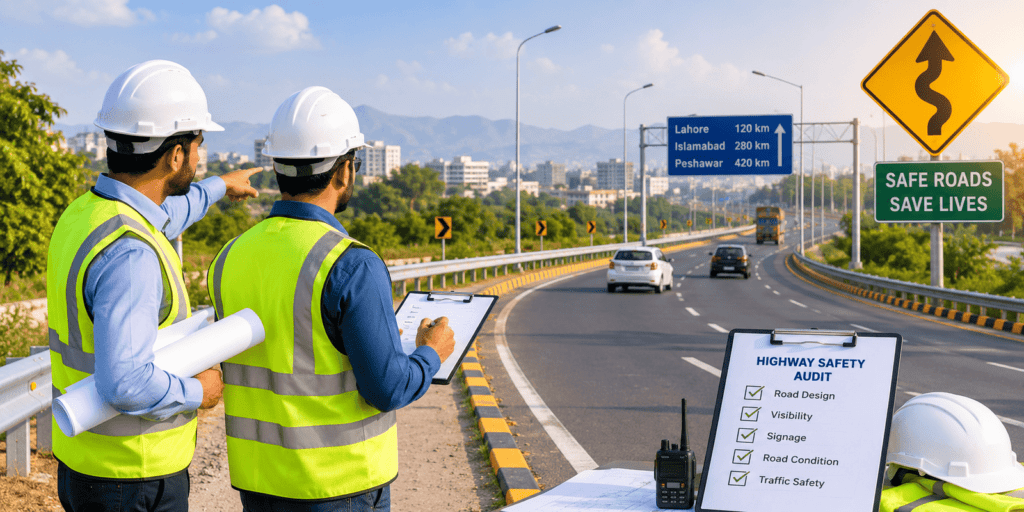
Every year, thousands of lives are lost on Pakistani roads. According to the National Highway and Motorway Police (NHMP), road accidents claim over 25,000 lives annually in Pakistan, with many more left injured or permanently disabled. Behind most of these tragedies lies a common thread: roads that were not designed, reviewed, or maintained with safety as the top priority — a problem we explored in detail in our piece on the importance of road safety equipment in preventing accidents.
This is exactly where the highway safety audit process comes in. A structured, step-by-step review of road design and conditions, highway safety audits have helped countries across the world cut road fatalities dramatically. Pakistan, with its expanding motorway network and growing CPEC-related infrastructure, stands at a crossroads — the right investment in safety auditing today can save countless lives tomorrow.
Table of Contents
ToggleWhat Is a Highway Safety Audit?
A highway safety audit (HSA) is a formal, independent examination of a road project or existing road to identify safety problems and recommend corrective measures. It is not about fault-finding or blame. It is a proactive tool that evaluates whether a road is as safe as it can be for all users: drivers, motorcyclists, cyclists, and pedestrians.
The audit is carried out by a trained team of road safety experts who physically inspect the road, review design documents, and assess conditions at different times of day. Their findings are documented in a formal report with clear recommendations for improvement.
The concept was first developed in the United Kingdom in the late 1980s and has since been adopted worldwide, including by the Asian Development Bank (ADB) and World Bank for projects in developing countries like Pakistan.
Types of Highway Safety Audits
Not all safety audits are the same. The type of audit performed depends on the stage of the road project or the condition of the existing network.
- Stage 1 – Feasibility and Preliminary Design Audit: conducted at the planning stage before construction begins. The team reviews route alignment, intersections, and design concepts to catch safety issues early, when changes are cheapest to make — the same early-stage thinking we cover in how highway expansion projects are planned and executed.
- Stage 2 – Detailed Design Audit: reviews the complete engineering drawings and technical specifications, checking lane widths, sight distances, road markings, signage, and drainage plans.
- Stage 3 – Pre-Opening Audit: carried out just before a new road is opened to traffic. The team physically walks and drives the road to spot anything that may have been missed in design — sharp edges, missing guardrails, confusing signs, or blind spots.
- Stage 4 – Operational Audit (In-Service Audit): performed on roads already open and in use, using accident data, site observations, and driver behaviour studies to identify problem locations and recommend targeted fixes.
In Pakistan, Stage 4 operational audits are particularly valuable given the existing condition of many national and provincial highways, and they increasingly intersect with the kind of smart-infrastructure thinking covered in our roundup of top highway construction trends.
The Highway Safety Audit Process Explained Step by Step
Understanding the highway safety audit process clearly is important for engineers, road planners, government officials, and even the general public. Here is how the process works from start to finish.
Step 1: Forming the Audit Team
Every highway safety audit begins with assembling the right team. A typical HSA team includes a road safety engineer, a traffic engineer, and sometimes a human factors specialist or a local road authority representative. The team must be independent — meaning they were not involved in designing the road being audited. Independence is crucial; when the people who designed a road also evaluate it, blind spots are inevitable. An outside team brings a fresh perspective.
Step 2: Collecting Background Information
Before the site visit, the audit team collects all available data: road design drawings and specifications, accident records, traffic volume counts, speed data, and any previous maintenance or safety reports. Pavement condition history is part of this picture too — our guide on pavement life cycle cost analysis explains how that data is gathered and used to plan maintenance and prioritise risk.
In Pakistan, this data is often held by the National Highway Authority (NHA), provincial highway departments, or the NHMP. Accessing complete and accurate records can sometimes be a challenge, which is itself a systemic issue worth addressing.
Step 3: The Site Visit
This is the most hands-on part of the process. The audit team visits the road during both daylight and night-time conditions, and sometimes during rain or fog to assess visibility and surface conditions. During the visit, the team looks for a wide range of safety concerns:
- Poor horizontal or vertical alignment, and unsafe intersections or merging points — the issues our guide on how modern road design improves traffic flow is built around.
- Inadequate road markings and signage. This is one of the most common findings on Pakistani roads; see our breakdowns of critical road marking mistakes and our complete guide to paint for road marking for what compliant markings should look like.
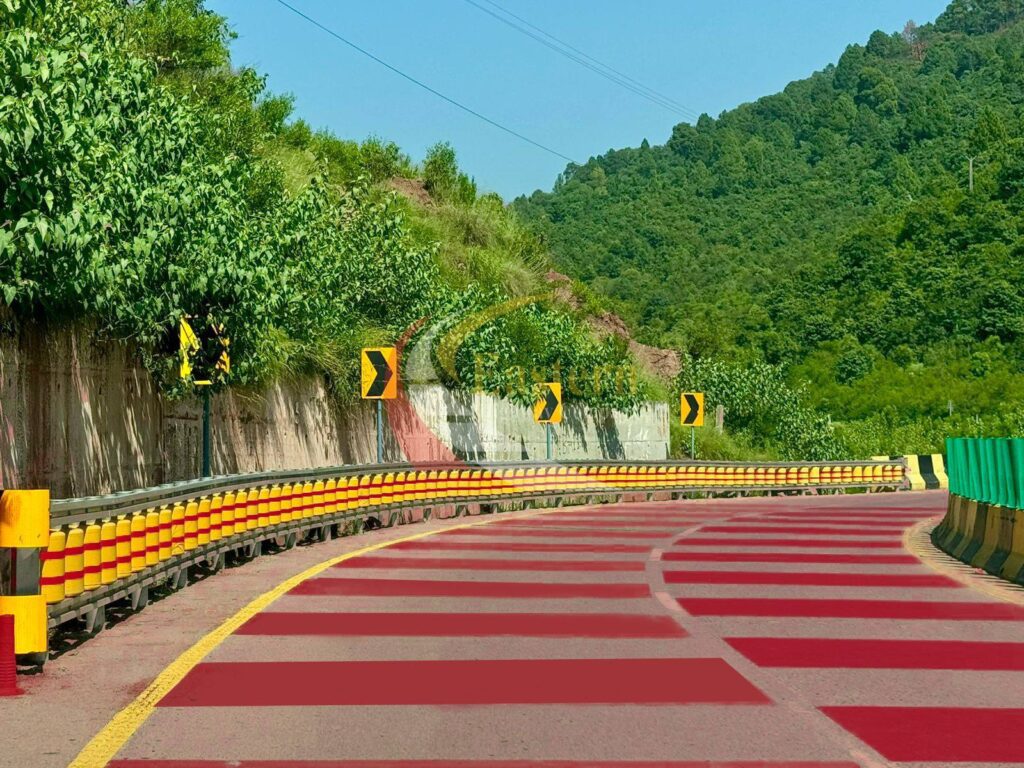
- Missing or damaged guardrails and barriers, covered in depth in our piece on roller barrier guard rail systems.
- Poor drainage leading to flooding or slippery surfaces — a risk that’s intensifying, as we discuss in the impact of climate change on road infrastructure design.
- Pedestrian crossings that are unclear or dangerous, and roadside hazards like utility poles, trees, or unprotected embankments.
On Pakistan’s highways, common problems include unmarked speed bumps, missing kilometre markers, inadequate lighting near toll plazas, and poorly designed U-turns on expressways like the M-2 and M-9. Many of these gaps trace back to the same nighttime-visibility issues we cover in why reflective road signs are critical for nighttime driver safety.
Step 4: Identifying and Documenting Safety Issues
After the site visit, the team prepares a detailed list of every safety problem observed. Each issue is described clearly, along with its location, potential severity, and likely cause. Good audit documentation uses photographs, sketches, and GPS coordinates so that road authorities can quickly identify and act on the findings. Vague descriptions without location references are one of the most common shortcomings in poorly conducted audits.
Step 5: Developing Recommendations
For every safety issue identified, the audit team proposes a practical recommendation, usually categorised by urgency: immediate action required, short-term improvement needed, or long-term design change recommended. Recommendations must be realistic and cost-effective — in the context of Pakistan’s budget constraints, a recommendation to add retroreflective road markings or visibility aids like cateyes and road studs at dangerous rural bends is far more likely to be implemented than a proposal to completely reconstruct an intersection. Other common low-cost, high-impact fixes include convex mirrors at blind curves, delineator posts along unprotected embankments, anti-glare shields on undivided carriageways, and properly marked speed breakers at school zones and built-up areas.
Step 6: Preparing the Formal Audit Report
The findings and recommendations are compiled into a formal audit report, submitted to the road authority or project owner, who is then required to respond formally — either confirming they will implement the recommendation, explaining why it is not feasible, or proposing an alternative solution. This formal response requirement is what gives the audit process its teeth. Without it, reports risk being filed away and forgotten.
Step 7: Monitoring and Follow-Up
A safety audit is not complete when the report is submitted. A follow-up process is needed to check whether recommendations have actually been implemented and whether they achieved the desired safety improvement. Some countries build this follow-up into formal project requirements, tied to funding or regulatory compliance. In Pakistan, the ADB and World Bank have begun including HSA requirements as a condition of infrastructure financing, which is encouraging progress.
Need Compliant Signs, Markings, or Barriers Fast?
Talk to Eastern Highway: Contact Us
Why Highway Safety Audits Matter in Pakistan
Pakistan’s road network spans over 264,000 kilometres, ranging from modern motorways to rural katcha roads. Road traffic injuries are the leading cause of death among people aged 5 to 29 in the country, according to data compiled by the World Health Organization. The economic cost is equally staggering: road accidents are estimated to cost Pakistan between 1.5% and 3% of GDP annually in direct and indirect losses, including medical costs, lost productivity, and infrastructure damage.
- They prevent accidents before they happen. Identifying a dangerous curve, a missing warning sign, or a poorly lit pedestrian crossing before an accident occurs is far cheaper and more humane than responding after a tragedy.
- They make the most of limited resources. Pakistan cannot afford to rebuild all its roads at once. Safety audits help prioritise the highest-risk locations and recommend low-cost, high-impact fixes.
- They support accountability. When safety problems are formally documented and road authorities are required to respond, there is a clear record of who knew what and when.
- They improve CPEC infrastructure outcomes. Billions of dollars are being invested in roads, expressways, and transport corridors under CPEC — corridors Eastern Highway has worked on directly, including the Hazara Motorway (Thakot–Havelian), the Karakoram Highway, and the Multan–Sukkur Motorway. Building safety audit requirements into projects like the Lahore–Sialkot Motorway ensures new infrastructure meets international standards from day one.
Highway Safety Audits and Pakistani Road Standards
Pakistan’s road design is governed by the NHA’s Geometric Design Standards, which draw from AASHTO (American) and British guidelines. However, compliance with these standards does not automatically guarantee safety — many accidents happen on roads that technically meet design specifications. This is why safety audits go beyond checking boxes on a design checklist; they evaluate real-world conditions, human behaviour, and the interaction between road design and actual traffic, including some of the urban-specific pressures we outline in key challenges in urban highway development today.
Pakistan’s Motorway Police has increasingly engaged with safety audit concepts, and the NHA has conducted audits on select projects, but systematic, nationwide adoption remains a goal rather than a reality. Provincial road departments in Punjab, Sindh, Khyber Pakhtunkhwa, and Balochistan have varying levels of capacity for safety auditing, and training qualified audit teams is a major need.
Who Conducts Highway Safety Audits in Pakistan?
Currently, highway safety audits in Pakistan are conducted through a mix of NHA internal teams, international consultants hired under donor-funded projects, and a small but growing number of local engineering firms with safety training. The Road Safety Fund of Pakistan and international partners like the ADB, World Bank, and UK’s Foreign, Commonwealth and Development Office (FCDO) have all supported safety audit training programmes in recent years.
Once an audit’s recommendations are approved, implementation depends on having a reliable supplier who can deliver compliant products at scale. As an ISO 9001:2015 certified manufacturer with a track record on NHA, FWO, and NLC projects — see our client list and completed projects — Eastern Highway is well positioned to help road authorities and contractors turn audit recommendations into installed, standards-compliant infrastructure. Learn more about our background on our company profile page.
Need Compliant Signs, Markings, or Barriers Fast?
Reach our team: Contact Us
Frequently Asked Questions
Is a highway safety audit the same as a road inspection?
No. A road inspection typically checks the physical condition of a road — potholes, cracks, markings. A safety audit is a broader, independent evaluation of whether the road design and environment could cause or contribute to accidents.
How long does a highway safety audit take?
It depends on the length and complexity of the road. A single intersection audit may take a few days. An audit of a major highway corridor could take several weeks, including office review, site visits, and report writing.
Are safety audits compulsory in Pakistan?
There is no current legislation in Pakistan that makes safety audits compulsory for all road projects. However, donor-funded projects often require them as a condition of financing, and NHA has adopted them as a recommended practice for major projects.
Can safety audits be done on rural roads?
Yes. In fact, rural roads in Pakistan often carry the highest accident risk due to poor design, lack of markings, and mixed traffic including pedestrians, motorcycles, and heavy vehicles. Safety audits on rural roads can have an outsized impact.
What happens if audit recommendations are ignored?
In countries with strong regulatory systems, ignoring audit recommendations can result in legal liability. In Pakistan, accountability mechanisms are still developing, but donor pressure and public attention to road safety are increasingly important drivers of action.
How much does a highway safety audit cost?
Costs vary widely. A basic operational audit of a short road section can be done relatively cheaply. A comprehensive Stage 1 to 3 audit of a major highway project may cost millions of rupees, but this is a fraction of the long-term cost of accidents on poorly designed roads.
Final Thoughts
The highway safety audit process is not just a technical exercise for engineers. It is a commitment to the idea that every person who travels on a road deserves to arrive safely. For Pakistan, where road fatalities rob families of loved ones every single day, making safety audits a standard and mandatory part of road planning, construction, and maintenance is not optional — it is urgent.
From the mountain roads of KPK to the motorways connecting Karachi to Lahore, every kilometre of Pakistan’s road network can be made safer. Highway safety audits are one of the most proven, cost-effective tools available to make that happen. Browse more traffic engineering insights on our blog or contact Eastern Highway to discuss how we can help implement your next audit’s recommendations.
Internal Linking Map (QA Reference — remove before publishing)
For your reference: every internal link placed in this draft, with anchor text and destination, so you can verify before this goes live on easternhighway.com.
Anchor Text | Destination URL |
importance of road safety equipment in preventing accidents | https://easternhighway.com/importance-of-road-safety-equipment-in-preventing-accidents/ |
how highway expansion projects are planned and executed | https://easternhighway.com/how-highway-expansion-projects-are-planned-and-executed/ |
top highway construction trends | https://easternhighway.com/highway-construction-trends/ |
pavement life cycle cost analysis | https://easternhighway.com/what-is-pavement-life-cycle-cost-analysis-and-why-it-matters-in-pakistan/ |
how modern road design improves traffic flow | https://easternhighway.com/how-modern-road-design-improves-traffic-flow-complete-guide/ |
critical road marking mistakes | https://easternhighway.com/critical-road-marking-mistakes/ |
complete guide to paint for road marking | https://easternhighway.com/paint-for-road-marking-a-complete-guide/ |
roller barrier guard rail systems | https://easternhighway.com/how-roller-barrier-guard-rail-systems-improve-road-safety/ |
impact of climate change on road infrastructure design | https://easternhighway.com/climate-change-impact-road-infrastructure-design/ |
why reflective road signs are critical for nighttime driver safety | https://easternhighway.com/why-reflective-road-signs-are-critical-for-nighttime/ |
road markings (service page) | https://easternhighway.com/road-marking/ |
cateyes and road studs (product category) | https://easternhighway.com/product-category/cateyes-road-studs/ |
convex mirrors (product category) | https://easternhighway.com/product-category/convex-mirrors/ |
delineator posts (product page) | https://easternhighway.com/delineator-post/ |
anti-glare shields (product page) | https://easternhighway.com/anti-glare-shield/ |
speed breakers (product category) | https://easternhighway.com/product-category/speed-breakers/ |
key challenges in urban highway development today | https://easternhighway.com/key-challenges-in-urban-highway-development-today/ |
Hazara Motorway (Thakot–Havelian) project page | https://easternhighway.com/hazara-motorway-thakot-havelian-cpec/ |
Karakoram Highway project page | https://easternhighway.com/karakoram-highway/ |
Multan–Sukkur Motorway project page | https://easternhighway.com/multan-sukkur-motorway-cpec/ |
Lahore–Sialkot Motorway project page | https://easternhighway.com/lahore-to-sialkot-motorway/ |
ISO 9001:2015 certifications page | https://easternhighway.com/certifications/ |
client list | https://easternhighway.com/clients/ |
completed projects | https://easternhighway.com/projects-completed/ |
company profile | https://easternhighway.com/profile/ |
blog index | https://easternhighway.com/blogs/ |
contact us (x2 CTA + closing) | https://easternhighway.com/contact-us/ |