

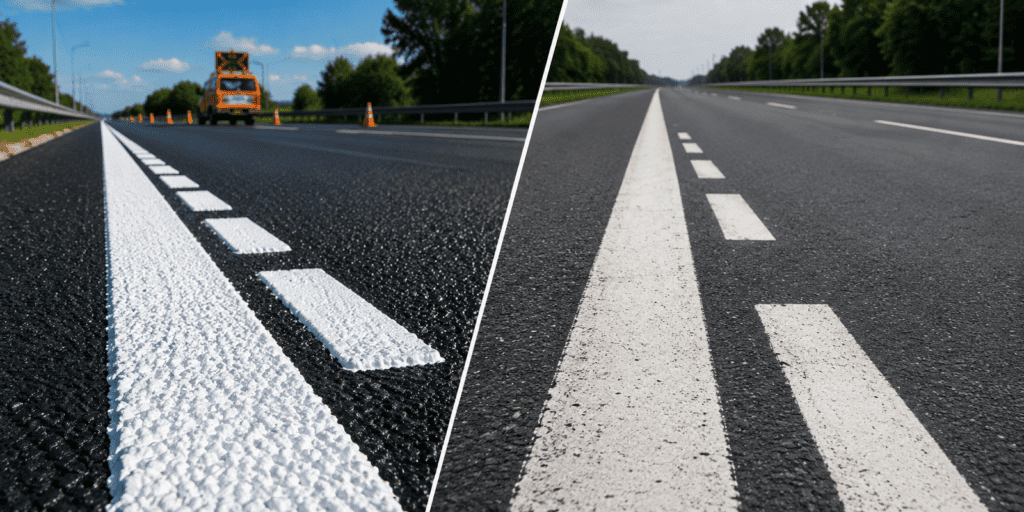
Road markings are the silent communicators of every highway. Lane lines, stop bars, pedestrian crossings, arrows, and edge markings guide drivers, manage traffic flow, and prevent accidents. The material those markings are made from determines how long they last, how visible they remain, and how much they ultimately cost over the life of a road project.
In Pakistan, road infrastructure investment is growing steadily. From national highway upgrades to CPEC corridor projects, billions of rupees are being spent on roads that need to perform for decades. Choosing the wrong road marking material means faded lines within months, higher maintenance costs, and reduced road safety at a time when Pakistan can least afford it.
The choice typically comes down to two options: standard road marking paint or thermoplastic road marking. Both serve the same purpose. Their performance, however, is vastly different. This guide compares both materials honestly across every factor that matters for highway projects, so contractors, road authorities, and project managers can make an informed decision.
Eastern Highway has delivered thermoplastic road marking projects across Pakistan’s national highway network. View our completed projects to see the scope of our work.
Table of Contents
ToggleAt a Glance: Thermoplastic vs Standard Paint
Factor | Standard Paint | Thermoplastic |
Service Life | 6–12 months | 3–7 years |
Night Visibility | Poor after fading | Excellent (glass beads) |
Wet Weather Performance | Very limited | Strong retroreflectivity |
Upfront Cost | Lower | Higher |
Lifecycle Cost | High (frequent reapplication) | Lower overall |
Heat & UV Resistance | Degrades faster | Formulated to withstand |
Bond to Road Surface | Thin film only | Chemical & mechanical bond |
Suitable for Highways | No (temporary use only) | Yes (recommended) |
What Is Standard Road Marking Paint?
Standard road marking paint is a water-based or solvent-based acrylic liquid applied cold directly onto the road surface. It is widely used because it is inexpensive, quick to apply, and does not require specialised heating equipment. Application is straightforward: a spray or roller system applies the paint in a thin film that dries through evaporation within minutes.
The trade-off for that simplicity is performance. Standard paint sits on the road surface as a thin film. It does not bond chemically or mechanically into the road material the way thermoplastic does. Traffic friction, UV exposure, rain, and temperature variation all wear it down relatively quickly.
On a busy highway in Pakistan, where heavy commercial vehicles, motorcycles, and rickshaws share the same road surface, standard paint typically lasts between 6 and 12 months before becoming visibly faded and functionally inadequate. In high-traffic urban environments and on arterial roads, this timeline can be even shorter.
Standard paint may be suitable for temporary or low-traffic applications. For high-traffic roads, explore Eastern Highway’s traffic safety product range for longer-lasting solutions.
What Is Thermoplastic Road Marking?
Thermoplastic road marking is a fundamentally different material. It is a solid compound at room temperature, composed of synthetic resins, plasticisers, high-quality pigments, fillers, and glass beads for retroreflectivity. It becomes liquid when heated to between 190°C and 210°C, and is then applied to the road surface by specialised extrusion or spray equipment.
As the material cools, it hardens into a thick, durable layer that bonds firmly to the road surface. The applied thickness typically ranges from 90 to 120 mils, compared to the much thinner film left by standard paint. That thickness and the bond formed during cooling are the foundation of thermoplastic’s superior performance.
Glass beads are embedded throughout the material during manufacturing, and additional beads are dropped onto the surface immediately after application. These beads reflect vehicle headlights directly back toward the driver, providing retroreflective visibility that standard paint cannot replicate, especially at night and in wet conditions.
Thermoplastic road marking in Pakistan is increasingly specified by national highway authorities, provincial road departments, and major infrastructure contractors precisely because of this performance difference. For projects where longevity, safety, and reduced maintenance are the priorities, thermoplastic is the material that delivers.
See how thermoplastic performs in real highway conditions: watch our project videos.
Durability: The Most Important Difference
Durability is where the gap between thermoplastic and standard paint is most stark and most relevant for highway project planning.
Standard road marking paint lasts 6 to 12 months on high-traffic roads. On national highways and motorways carrying heavy commercial vehicle loads, the upper end of that range is optimistic. Markings freshly applied in one budget cycle are often already faded before the next maintenance window arrives.
Thermoplastic markings deliver a service life of 3 to 5 years on high-traffic roads under normal conditions, with some installations lasting considerably longer where traffic loads are moderate and the road surface is well maintained. Several industry sources indicate a service life of up to 7 to 8 years on roads with lower traffic intensity.
That difference means a single thermoplastic application replaces 3 to 6 standard paint applications over the same period. On a highway project covering hundreds of kilometres, the cumulative cost of those repeated paint applications consistently exceeds the higher upfront investment in thermoplastic.
Eastern Highway’s thermoplastic projects span national highways, motorways, and CPEC corridors. See projects in progress across Pakistan.
Retroreflectivity and Night Visibility
Visibility is not just an aesthetic quality of road markings. It is a direct road safety measure. Markings that cannot be clearly seen at night or in wet conditions fail at their core function of guiding and informing drivers.
Standard paint offers acceptable daytime visibility when freshly applied. As it fades, daytime visibility deteriorates. At night and in rain, standard paint has very limited retroreflective performance. It contains no embedded glass beads and does not return vehicle headlights toward the driver. Once faded, it becomes difficult to see in low-light conditions even for an alert driver paying full attention.
Thermoplastic markings contain glass beads, both premixed throughout the body of the material and applied to the surface during installation. These beads capture vehicle headlights and return them directly toward the driver’s eyes, creating a marking that appears bright and clearly visible at night and in the rain.
Critically, because beads are distributed throughout the full depth of the thermoplastic material, they continue performing as the surface layer wears down. Fresh beads are continuously exposed as the marking ages. Standard paint has no equivalent self-renewing mechanism.
On Pakistan’s unlit rural highways and stretches of national highway where overhead lighting is absent, this retroreflective performance is not a premium feature. It is a fundamental safety requirement.
Complement thermoplastic markings with retroreflective road signs from Eastern Highway for a complete nighttime visibility solution.
Application: How Each Material Is Applied
Understanding the application process for both materials helps clarify why their performance outcomes are so different.
Standard Paint Application
Standard road marking paint is applied cold, directly from the container or a pressurised spray system. No preheating is required. Equipment is relatively basic and widely available. Paint dries through evaporation in 10 to 30 minutes under normal conditions. The resulting layer is thin and adheres to the road surface through physical contact only.
Thermoplastic Application
Thermoplastic is heated in a pre-heater boiler to between 190°C and 210°C until it becomes a uniform molten material. A road marking machine then applies the molten thermoplastic to the road surface using a screed box or spray system, depending on the marking type and specification. Glass beads are immediately dispersed over the fresh marking surface at a rate of approximately 400 to 500 grams per square metre.
The material cools and hardens quickly, typically allowing vehicles back onto the surface within minutes. The cooling process creates a chemical and mechanical bond with the road surface that standard paint does not form. This bonding is a major contributor to thermoplastic’s significantly longer service life.
Thermoplastic application requires trained operators and specialised equipment. For highway-scale projects, however, these requirements are easily met and the performance advantage far outweighs the additional process complexity.
Eastern Highway’s certified teams operate across Pakistan. View our certifications to learn more about our quality standards.
Cost Comparison: Upfront vs Lifecycle
The most common reason contractors and road authorities consider standard paint over thermoplastic is upfront cost. Standard paint has a lower material and application cost per square metre. Thermoplastic requires specialised heating equipment, trained operators, and a higher-cost material. The initial price difference is real.
What the upfront comparison misses is lifecycle cost: the total cost of a marking over the period it needs to function on the road.
Standard paint lasting 6 to 12 months on a high-traffic highway needs to be reapplied 3 to 6 times over the same period where a single thermoplastic application remains effective. Each reapplication involves material cost, equipment deployment, labour, road closure or traffic management, and administrative overhead. Multiply these costs across hundreds of kilometres of highway marking and the financial case for thermoplastic becomes clear.
Thermoplastic road marking in Pakistan is consistently specified by highway authorities and major contractors who have done this lifecycle calculation. The higher upfront investment produces measurable long-term savings, not just in maintenance costs but in reduced road closures, fewer project mobilisations, and more consistent safety performance.
Planning a highway road marking project?
Performance in Pakistan’s Climate
Pakistan’s climate creates demanding conditions for road markings. Summers bring surface temperatures that can exceed 50°C on asphalt. Monsoon rains flood road surfaces for extended periods. UV intensity across most of the country accelerates the degradation of materials not specifically formulated for tropical and semi-arid conditions.
Standard paint degrades faster in these conditions than in temperate climates. UV bleaching causes colour loss. Heat softens the thin paint film. Rain and standing water break down acrylic binders. Dust and grit from heavy vehicle traffic abrade the surface at an accelerated rate.
Thermoplastic performs reliably across these conditions. The resin-based binder system withstands heat without softening significantly. The thick applied layer provides a depth of material that UV and abrasion must work through before the marking fails. Pakistan’s temperature range falls well within the operational parameters where thermoplastic delivers its best results.
Read more about road infrastructure challenges: The Impact of Climate Change on Road Infrastructure Design.
Which One Is Right for Highway Projects?
For highway projects in Pakistan, including national highways, motorways, provincial arterials, CPEC corridors, and urban expressways, thermoplastic road marking is the correct specification. The reasons are consistent across every performance dimension:
- It lasts 3 to 7 times longer than standard paint.
- It maintains retroreflective visibility at night and in wet conditions throughout its service life.
- It bonds firmly to the road surface rather than sitting as a thin film that wears quickly.
- Its lifecycle cost is lower than repeatedly reapplying cheaper paint.
- It performs reliably in Pakistan’s intense heat and UV conditions.
Standard paint has a genuine role in certain situations: temporary construction zone markings, low-traffic secondary roads, short-term project demarcation, and situations where the marking is explicitly temporary. For permanent or semi-permanent markings on any road carrying significant traffic, it does not meet the performance standard that highway infrastructure demands.
Explore Eastern Highway’s full range of traffic safety products and road marking solutions built to perform in Pakistan’s conditions.
Ready to specify thermoplastic road marking for your next highway project?
Related Reading
- Why Reflective Road Signs Are Critical for Nighttime Driver Safety in Pakistan
- What Is Pavement Life Cycle Cost Analysis and Why It Matters in Pakistan
- The Impact of Climate Change on Road Infrastructure Design
- Key Challenges in Urban Highway Development Today
- How Highway Expansion Projects Are Planned and Executed
Frequently Asked Questions
How long does thermoplastic road marking last compared to standard paint?
Standard road marking paint typically lasts 6 to 12 months on high-traffic highways. Thermoplastic road markings last 3 to 5 years under heavy traffic conditions, and up to 7 to 8 years on roads with lower traffic intensity. The difference means a single thermoplastic application replaces multiple paint applications over the same period.
Why does thermoplastic provide better night visibility than standard paint?
Thermoplastic contains glass beads, both premixed throughout the material and applied to the surface during installation. These beads retroreflect vehicle headlights directly back toward drivers, making markings clearly visible at night and in wet conditions. Standard paint has no glass beads and provides very limited retroreflective performance, especially after fading.
Is thermoplastic road marking more expensive than standard paint?
The upfront material and application cost of thermoplastic is higher than that of standard paint. Over the lifecycle of a highway project, however, thermoplastic is more cost-effective because it requires far less frequent reapplication. When all reapplication, traffic management, and labour costs are factored in, thermoplastic consistently delivers lower total cost.
Can standard paint be used on national highways in Pakistan?
Standard paint is not appropriate for permanent markings on high-traffic national highways. It fades too quickly to maintain safe visibility standards under the traffic volumes and climate conditions Pakistan’s highway network experiences. It is suitable only for temporary or low-traffic applications.
What makes thermoplastic suitable for Pakistan’s climate?
Thermoplastic road marking is formulated with resin-based binders that withstand high temperatures, intense UV exposure, and extended wet conditions, all of which are present across Pakistan’s road network. Its thick applied layer resists the abrasion of heavy vehicle traffic better than the thin film produced by standard paint, making it well-suited to the demands of Pakistan’s highway environment.
Have more questions? Contact Eastern Highway and our team will be happy to advise on the right specification for your project.