



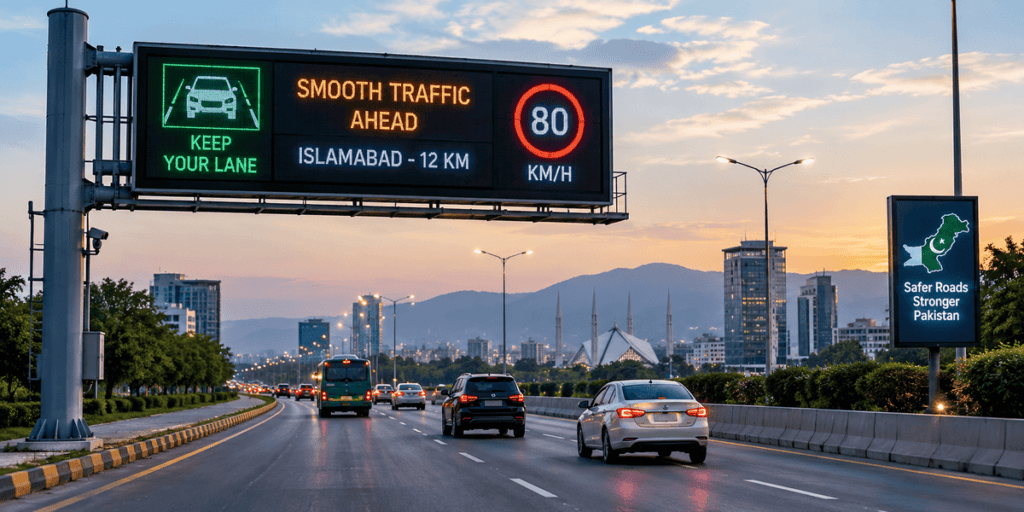
Traffic conditions can change within minutes. An accident, road closure, construction activity, heavy rain, or congestion can make a previously suitable route difficult to use. Traditional road signs provide important fixed information, but they cannot change when conditions change.
Variable Message Signs (VMS) help address this gap. Using electronic displays, often LED-based, they can show changing messages to drivers. These include traffic updates, warnings, diversions, speed advisories, and information about road conditions.
Pakistan is also moving toward more technology-based traffic management. Punjab Safe Cities Authority already uses VMS as part of its traffic management system in Lahore, while the federal government has directed work toward introducing Intelligent Transportation Systems on major highways. VMS is one part of this wider shift toward smarter roads.
Table of Contents
ToggleWhat Are VMS and LED Traffic Signs?
A Variable Message Sign (VMS) is an electronic road sign that can display different messages instead of showing one permanent message. Traffic authorities or operators can change the information when road conditions require it.
LEDs are commonly used to create these displays because they can produce bright, visible text and symbols for outdoor use.
Depending on the system, a VMS display:
- Traffic warnings
- Road closures
- Diversion information
- Accident or incident alerts
- Speed advisories
- Weather or road-condition warnings
- Work-zone messages
- Travel or destination information
Some systems can be controlled remotely through a traffic management network. Others use local programming or another control method. The exact features depend on the design and control system installed.
Why VMS Matters for Traffic Management in Pakistan
Pakistan’s roads include busy urban routes, motorways, highways, bridges, tunnels, and rapidly developing road networks. Traffic conditions can vary considerably across these locations.
A fixed sign cannot respond to every change. A VMS can provide information that is relevant to the current situation.
For example, a sign can warn drivers about an accident ahead and direct them toward an alternative route. During road construction, it can communicate lane closures or reduced speeds. In poor weather, it can display an appropriate warning for drivers approaching the affected area.
This gives traffic managers another way to communicate directly with road users when conditions change.
VMS vs. Traditional Road Signs
Traditional signs remain essential because they communicate permanent traffic rules and road information. VMS serves a different purpose.
|
Traditional Road Signs |
VMS |
|
Usually display fixed information |
Can display changing information |
|
Used for permanent rules and warnings |
Useful for temporary or changing conditions |
|
Do not require electronic power |
Requires a suitable power system |
|
Simple to operate and maintain |
Requires electronic equipment and maintenance |
|
Cannot respond to changing incidents |
Can communicate updated information when supported by the control system |
The two should not be treated as alternatives. A well-designed road system needs both fixed signs and dynamic information where appropriate.
How VMS Can Support Smarter Highways
VMS becomes particularly useful when it is connected to a broader traffic management system.
Consider a motorway where an accident blocks part of the carriageway. A traffic management system receive information about the incident. An appropriate VMS can then warn approaching drivers and provide instructions based on the traffic plan.
Similar applications can include:
Traffic Diversions
When a route is temporarily closed or congested, VMS can inform approaching drivers about a diversion or alternative route.
Incident Warnings
Accidents, stalled vehicles, road obstructions, and other incidents can create unexpected hazards. A warning displayed before the affected area can give drivers time to adjust their speed or route.
Road and Weather Conditions
Messages can be used to warn drivers about conditions such as fog, reduced visibility, or other temporary road hazards when the traffic management system has reliable information to communicate.
Speed Advisories
VMS can display temporary speed-related warnings around work zones, incidents, or other locations where drivers need additional caution.
Work-Zone Management
Construction areas often require temporary traffic arrangements. VMS can support these arrangements by communicating lane closures, work activity, reduced speeds, or other relevant instructions.
The effectiveness of these messages depends on accurate information, appropriate placement, clear wording, good visibility, and drivers responding to the information.
Where Can VMS and LED Signs Be Used?
VMS is not limited to motorways. Its usefulness depends on the traffic problem and the information that needs to reach road users.
Motorways and Highways
Large roads can benefit from dynamic information about incidents, congestion, diversions, road conditions, and planned work.
Urban Roads
Busy city routes can use VMS to communicate temporary closures, traffic restrictions, event-related changes, or other road information.
Construction Zones
Road work can change lane arrangements from one stage to another. A dynamic sign can provide updated instructions without requiring a completely new permanent sign for every temporary change.
Bridges and Tunnels
These locations can have limited alternative routes and specific safety concerns. VMS can provide warnings or operational information when conditions change.
Major Intersections and Approaches
VMS can also be useful upstream of important junctions where drivers need information before choosing a route.
Solar-Powered vs. Electric VMS
Power is an important consideration when installing VMS.
An electric-powered sign can be suitable where reliable grid power is already available. It can be a practical option for permanent installations with established electrical infrastructure.
Solar-powered VMS can be useful at locations where connecting to the grid is difficult or expensive. However, the system needs suitable solar exposure, battery capacity, and regular maintenance.
The right choice depends on the location, operating requirements, available infrastructure, weather conditions, and maintenance plan. Solar power should not automatically be treated as the better option for every site.
What Should You Check Before Choosing a VMS?
A VMS should be selected according to the road, traffic conditions, and type of information it needs to display.
Display Size and Viewing Requirements
The display needs to be large and clear enough for drivers to read the message with sufficient time to respond. The appropriate size depends on the road environment, message length, traffic speed, and installation location.
Visibility
Brightness, contrast, viewing angle, and performance in different lighting conditions all affect how easily drivers can read the sign.
Message Format
Messages should be short and easy to understand. The system should support the text, symbols, or display formats required for the intended application.
Control and Connectivity
Check how the sign will be programmed or controlled. Some systems support remote communication, while others use local controls such as USB or other programming methods.
Power Supply
Consider grid electricity, solar power, battery requirements, backup arrangements, and the availability of power at the installation site.
Maintenance
Outdoor electronic equipment needs regular inspection and maintenance. The sign should be accessible for servicing, and replacement parts and technical support should be considered before installation.
VMS Does Not Replace Basic Road Safety Measures
Dynamic signs are useful, but they are only one part of traffic management.
Drivers still need clear road markings, regulatory signs, warning signs, traffic signals, barriers, delineators, and other safety measures. A VMS cannot compensate for poor road design or missing basic traffic controls.
Its greatest value comes when dynamic information works alongside the rest of the road safety system.
Is VMS the Future of Traffic Management in Pakistan?
VMS is already being used in Pakistan, particularly as part of technology-based traffic management systems. Its role is likely to become more important as road authorities move toward Intelligent Transportation Systems.
The federal government’s recent direction to advance ITS on major highways shows that technology is becoming a bigger part of Pakistan’s road infrastructure planning.
Still, VMS should be viewed as one component of a wider system. Cameras, communications networks, traffic signals, traffic management centres, electronic tolling, road monitoring, and other technologies can work together to create a more responsive transport network.
The future is not simply about putting electronic signs beside roads. It is about connecting reliable information with the infrastructure needed to communicate it effectively to road users.
How to Choose the Right VMS for a Road Project
Start with the traffic problem you want the sign to address.
Ask:
- What information will drivers need?
- Where will the sign be installed?
- How fast will traffic be moving?
- How much time will drivers have to read the message?
- Will the sign need remote control?
- Is grid power available?
- Would solar power be practical?
- What weather conditions will the equipment face?
- Who will operate and maintain the system?
These questions help determine the appropriate display, power arrangement, control method, and installation setup.
For road authorities, contractors, and infrastructure developers in Pakistan, choosing the right VMS is not simply a matter of selecting the largest or brightest display. The system needs to fit the road environment and the traffic-management purpose.
Final Words
VMS and LED signs are becoming an important part of smarter traffic management. These give road authorities a way to communicate changing information when fixed signs cannot provide enough flexibility.
As Pakistan develops its Intelligent Transportation Systems, dynamic signs can support safer work zones, incident management, diversions, weather warnings, and other temporary traffic needs. Their success will depend on accurate information, suitable installation, reliable power, clear messaging, and proper maintenance.
For organizations planning traffic safety and intelligent road infrastructure projects, Eastern Highway provides VMS, LED, and other traffic-management solutions for different applications.
FAQs
Can VMS signs display different messages at different times?
Yes. A VMS is designed to display changeable information. The available programming and control methods depend on the specific system and how it is configured.
Are VMS signs useful during road construction?
Yes. They can communicate temporary information such as lane restrictions, work-zone warnings, or diversions. They should be used alongside the other traffic-control measures required for the project.
How far away should a VMS sign be placed from a junction or hazard?
There is no single distance that applies to every location. Placement depends on factors such as vehicle speed, viewing distance, road geometry, message complexity, and the point where drivers need to make a decision.
Can a VMS work without an internet connection?
It depends on the control system. Some signs can be programmed locally, while network-connected systems allow messages to be managed remotely.
Do VMS signs work during power outages?
The answer depends on the power configuration. A system with suitable battery backup or solar power can continue operating during a mains-power interruption for a limited period.
Are VMS signs suitable for every road in Pakistan?
Not necessarily. A VMS is most useful where changing information needs to reach drivers. For roads that mainly require permanent warnings, directions, or regulatory information, conventional signs may be more appropriate or may work alongside a VMS.
What is the difference between VMS and an LED traffic sign?
VMS refers to the ability to display changing messages. LED describes the light-emitting technology used in many electronic displays. A VMS can therefore use LED technology while providing changeable traffic information.