

Speed limits do not always stop drivers from speeding. A driver see a 60 km/h limit but continues travelling at 70 or 75 km/h without paying much attention to the difference.
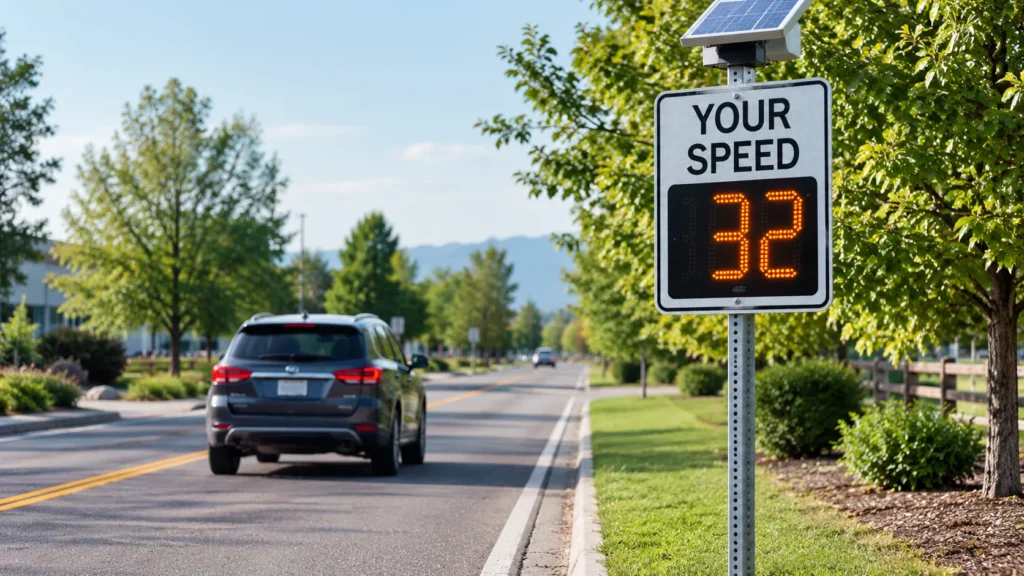
Driver feedback signs take a more direct approach. They detect a vehicle’s speed and display it to the driver, often with a message such as “YOUR SPEED” or “SLOW DOWN.”
But do these signs actually make people slow down?
Research suggests that they can reduce vehicle speeds, especially at locations where drivers need to slow down. Their effect is not the same everywhere, though. Placement, visibility, road conditions, and how the sign is used all matter.
Table of Contents
ToggleWhat Are Driver Feedback Signs?
Driver feedback signs are electronic speed-display signs that measure an approaching vehicle’s speed and provide immediate feedback.
Most systems use a speed-detection device such as radar. The display can show the vehicle’s current speed and may activate a warning when the driver exceeds a selected speed.
For example:
Speed Limit: 60 km/h
Your Speed: 74 km/h
Some signs simply display the detected speed. Others can show messages such as “SLOW DOWN” or “REDUCE SPEED.”
The purpose is not to issue a fine. It is to make drivers aware of their speed while they still have time to slow down.
Do Driver Feedback Signs Actually Reduce Speeding?
Yes, research has found that they can.
A major review of studies on dynamic speed feedback signs found significant reductions in vehicle speeds across different road settings and vehicle types. The research estimated an average reduction of about 4 mph for passenger vehicles at the sign location, with reductions of around 2 to 4 mph across the vehicle types and settings studied.
Other research has found that the signs can be particularly useful at curves, speed-transition areas, school zones, and work zones. Faster drivers also respond more strongly to feedback signs than drivers who were already travelling at lower speeds.
That does not mean every sign will produce the same reduction. A poorly placed sign or one used in the wrong location may have little effect.
Why Does Seeing Your Speed Help?
A normal speed-limit sign tells drivers how fast they should be travelling.
A feedback sign tells them how fast they are actually travelling.
That difference can catch attention.
A driver who thinks they are travelling at 60 km/h may realise they are actually doing 72 km/h when the number appears on the display. That immediate feedback gives them a chance to adjust their speed before reaching a sensitive location.
The approach is simple: instead of relying only on a fixed warning, the sign responds to the driver’s current speed.
Read our Helpful Blog on the Topic: “Why Reflective Road Signs Are Critical for Nighttime Driver Safety in Pakistan”.
Where Can Driver Feedback Signs Be Used?
The signs are most useful where speeding creates a specific safety concern.
School and Pedestrian Areas
Drivers approaching schools, pedestrian crossings, or other areas with high pedestrian activity may need an extra reminder to slow down.
A speed feedback sign can show the driver’s speed before they reach the area.
Sharp Curves
Speed that feels acceptable on a straight road may be too high for a sharp curve.
Feedback signs can be placed before curves to remind drivers to reduce speed before entering them. Research has found speed reductions at rural curves and other speed-sensitive locations.
Work Zones
Road construction can change lanes, road width, traffic flow, and speed limits.
A driver feedback sign can reinforce a temporary speed restriction and draw attention to the need to slow down. It should still be used with proper work-zone signs, barriers, cones, and other traffic-control measures.
Speed-Transition Areas
Some roads move quickly from a high-speed environment to a lower-speed section. Examples include approaches to built-up areas, intersections, ramps, and other locations where drivers need to reduce speed.
A feedback sign can give drivers an immediate reminder before the transition.
Are Driver Feedback Signs Useful on Pakistani Roads?
They can be, particularly at locations where speeding is a known problem.
Potential applications in Pakistan include:
- Urban roads with recurring speeding
- School zones
- Pedestrian crossings
- Highway approaches to lower-speed areas
- Sharp curves
- Construction zones
- Intersections and roundabouts
- Entry points to built-up areas
The local road environment still needs to be considered. Traffic volume, road width, posted speed limits, visibility, pedestrian activity, and driver behaviour can all affect how useful a sign will be.
It is also important not to assume that results from studies in other countries will be identical on Pakistani roads. The technology can provide useful speed feedback, but its effectiveness needs to be considered within the conditions of the specific road.
What Makes a Driver Feedback Sign Effective?
Installing a digital display is not enough. Several factors can affect the result.
Clear and Visible Display
Drivers need to recognise the message quickly. The display should remain readable in daylight and at night and should be suitable for the road’s viewing conditions.
Accurate Speed Detection
The displayed speed needs to be reliable. Radar or another suitable detection system should accurately identify approaching vehicles.
Proper Placement
The sign should be positioned where drivers can see it with enough distance to react safely. A sign placed immediately before a curve or crossing may give a driver too little time to slow down.
Appropriate Speed Setting
The sign should be programmed according to the speed limit and purpose of the location. Showing the right information at the right threshold is important for meaningful feedback.
Limited and Purposeful Use
Feedback signs should not be installed everywhere simply because they are available.
FHWA guidance notes that using speed feedback signs too frequently can reduce their effectiveness. They are more useful when they are placed at locations where drivers have a clear reason to change speed.
Do They Replace Speed Enforcement?
No.
Driver feedback signs encourage drivers to change their behaviour by giving them immediate information. Speed enforcement works differently by creating the possibility of a legal penalty.
Research has found that feedback signs can work particularly well when combined with enforcement. One study found that periodic law enforcement alongside speed feedback signs produced stronger and more lasting speed reductions than feedback signs alone.
This is why feedback signs should be viewed as one part of speed management, not a replacement for enforcement.
Depending on the location, other measures may include:
- Appropriate speed limits
- Road markings
- Warning and regulatory signs
- Traffic calming
- Work-zone controls
- Police enforcement
- Speed cameras where appropriate and legally permitted
Do Drivers Get Used to These Signs?
They can become less responsive to a sign if it is used too often or placed where it has little relevance.
The effect can also be strongest close to the sign. Research has found that speed reductions may not continue as far downstream, particularly when there are no other speed-management measures.
This makes placement important.
A safety sign works best when it is connected to a genuine reason for drivers to slow down, such as a school zone, curve, work area, pedestrian crossing, or change in speed limit.
Driver Feedback Signs vs. Speed Breakers
Both can be used to manage vehicle speeds, but they work in different ways.
A driver feedback sign relies on information. It shows drivers their speed and encourages them to slow down.
A speed breaker changes the physical road environment and requires vehicles to reduce speed to pass over it safely and comfortably.
A feedback sign may therefore be more appropriate where authorities want to encourage drivers to adjust their speed without introducing a physical obstruction.
The two measures can also be used together where the road design calls for additional speed control.
So, Are Driver Feedback Signs Worth Using?
The evidence suggests yes, when they are used in the right place and as part of a wider speed-management plan.
Research has consistently found that dynamic speed feedback signs can reduce speeds at the sign location. They can be particularly useful at curves, school zones, work zones, and areas where drivers need to transition to a lower speed.
They should not, however, be treated as a guaranteed solution to speeding.
A sign needs accurate speed detection, good visibility, suitable placement, and a clear purpose. It also works better when supported by appropriate speed limits, road design, signs, markings, and enforcement.
For Pakistani road projects, the key question should not simply be “Should we install a driver feedback sign?” It should be “Where is speeding creating a problem, and will immediate speed feedback help address it?”
Conclusion
Driver feedback signs give motorists something a standard speed-limit sign cannot: immediate information about their actual speed.
Research shows that this can encourage drivers to slow down, particularly at locations where speed changes are important for safety. The strongest results come when the signs are properly positioned and used alongside other traffic-management measures.
For roads, highways, construction areas, and urban projects in Pakistan, Eastern Highway provides traffic safety and traffic-management solutions that can support safer speed management and broader road-safety requirements.
FAQs
Do driver feedback signs actually reduce speeding?
Yes. Research shows that dynamic speed feedback signs can reduce vehicle speeds, particularly at the sign location and at areas where drivers need to slow down.
How do driver feedback signs work?
The sign then displays the detected speed and show a warning when the vehicle exceeds the selected limit.
Where are driver feedback signs most useful?
They can be useful near school zones, pedestrian areas, curves, work zones, speed-transition areas, intersections, and approaches to lower-speed sections.
Can driver feedback signs replace speed enforcement?
No. They provide immediate speed feedback but do not replace enforcement. They can be used alongside appropriate signs, road markings, traffic-calming measures, and enforcement.