




Crash cushion barriers are installed where vehicles could strike a fixed roadside hazard. They are commonly used near guardrail ends, bridge structures, roadway dividers, gore areas, and other locations where a direct impact could cause serious damage.
Plastic and steel are both used in crash cushion systems, but comparing them simply by material can be misleading. A crash cushion may use plastic energy-absorbing components, steel structural parts, or a combination of materials. Its protection depends on the complete system, its crash-tested performance, and how it is installed.
This crash cushion barrier comparison explains the differences between plastic and steel systems and what to consider when selecting one for a road or highway project.
Table of Contents
ToggleWhat Is a Crash Cushion Barrier?
A crash cushion barrier, also called an impact attenuator, is designed to reduce the severity of a vehicle collision with a fixed object.
When a vehicle strikes the cushion, the system manages the vehicle’s kinetic energy through controlled deformation, crushing, or other energy-absorbing mechanisms. Depending on its design, a crash cushion can also redirect a vehicle after certain side impacts.
Common applications include:
- Ends of guardrails
- Concrete barriers
- Bridge approaches and abutments
- Roadway dividers
- Gore areas
- Toll facilities
- Other fixed roadside hazards
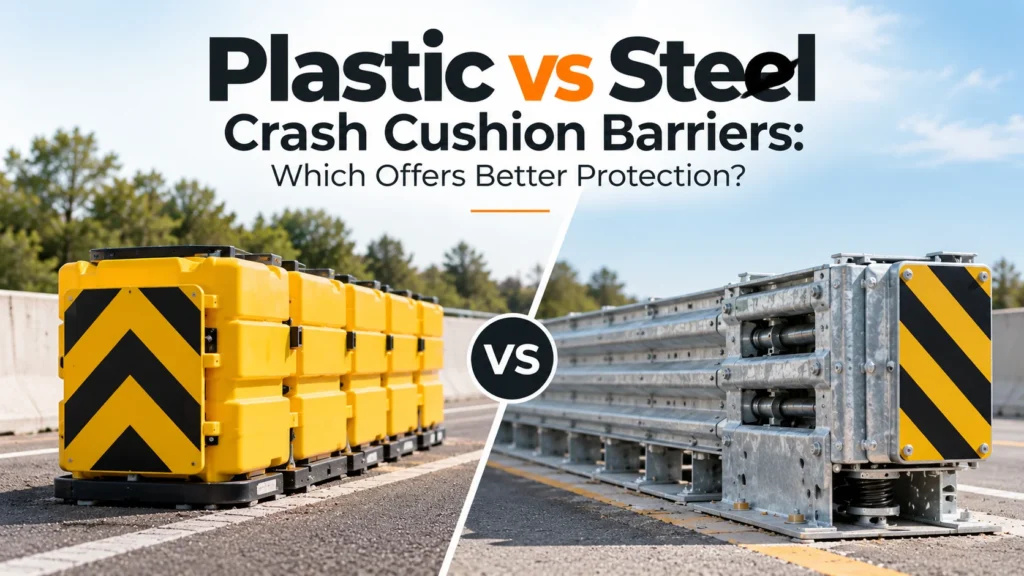
Eastern Highway’s ETEP Plastic Crash Cushion Barrier, for example, is a sand-barrel system designed to protect drivers from fixed objects such as concrete barriers, bridge abutments, and lighting fixtures.
Plastic Crash Cushion Barriers
Plastic crash cushions commonly use molded plastic modules or containers designed to absorb energy during an impact. Some systems use sand, water, or other energy-absorbing materials inside the modules.
The main advantage of this approach is that the modules can be designed to deform or collapse during a collision, helping dissipate the vehicle’s energy.
Benefits of Plastic Systems
Energy absorption
Plastic modules can be designed to collapse or deform during impact, helping manage collision energy.
Modular design
Individual units can make inspection and replacement more practical after a collision, depending on the system.
Practical installation
Some modular systems are easier to transport and position than heavier structural systems.
Suitable for different roadside applications
Plastic crash cushion systems can be used around fixed hazards where their design and tested performance meet the requirements of the location.
However, plastic should not automatically be considered weaker than steel. The material of the visible modules does not by itself determine the level of protection. The complete crash cushion system and its tested configuration are what matter.
Steel Crash Cushion Barriers
Steel is widely used in crash cushion structures, including frames, rails, brackets, panels, and other supporting components.
Some steel-based systems use energy-absorbing cartridges or other components within a structural framework.
Benefits of Steel Systems
Structural support
Steel can provide the framework needed to control the movement of the crash cushion during an impact.
Redirection
Some steel-supported crash cushions are designed to redirect vehicles after side-angle impacts.
Durability
Steel components can provide long-term structural performance when the system is correctly designed, installed, and maintained.
Permanent roadside applications
Steel components are used in many permanent crash cushion and barrier systems where the installation requires structural support.
These benefits do not mean that every steel crash cushion offers better protection than every plastic system. Crash performance depends on the design and testing of the complete system.
Plastic vs Steel Crash Cushion Barriers
Factor | Plastic-Based Systems | Steel-Based Systems |
Energy management | Use deformable or collapsible modules to absorb impact energy | Use structural deformation, cartridges, or other energy-absorbing components |
Structural support | Include separate steel frames or other supporting components | Steel can form a major part of the structural framework |
Weight | Some modular components can be relatively lightweight | Structural steel components are generally heavier |
Maintenance | Damaged modules can be replaceable depending on system design | Repairs involve structural components depending on the impact |
Redirection Depends on the complete system design Depends on the complete system design | Redirection Depends on the complete system design Depends on the complete system design | Redirection Depends on the complete system design Depends on the complete system design |
Application Can be used for suitable permanent or temporary applications Common in permanent and other high-demand applications | Application Can be used for suitable permanent or temporary applications Common in permanent and other high-demand applications | Application Can be used for suitable permanent or temporary applications Common in permanent and other high-demand applications |
Protection level | Determined by the tested system, not plastic alone | Determined by the tested system, not steel alone |
The comparison shows why material should not be the only factor when choosing an impact attenuator.
Also Read – Uses of Crash Cushion Barriers
Which Provides Better Protection?
There is no universal answer that plastic or steel provides better protection.
The important question is how the complete crash cushion performs during a crash.
Crash cushions are evaluated through crash testing against defined performance requirements. The eligibility letter is also specific to the tested system.
What Should You Consider When Choosing a Crash Cushion?
1. Expected Impact Conditions
The expected vehicle speeds, traffic conditions, and likely impact angles should be considered when selecting a crash cushion.
A system designed for one application may not be appropriate for another.
2. Type of Hazard
The cushion should match the object it is protecting. A barrier end, bridge structure, concrete divider, gore area, and other fixed hazards can have different requirements.
3. Available Space
The available roadside space can affect which crash cushion configuration is practical. The system needs to operate within the space and installation conditions for which it was designed and tested.
4. Redirection Requirements
Some crash cushions are designed to redirect vehicles after side impacts, while others are intended primarily to manage head-on impacts. This distinction matters when vehicles approach the hazard from different angles.
5. Crash-Test Performance
Check the crash-test level and applicable standard for the specific system. A crash cushion should be installed according to its tested and approved configuration. Changing important components can affect how the system performs during an impact. The eligibility documentation specifically limits acceptance to the configurations covered by the relevant testing and documentation.
6. Maintenance and Repair
The likely frequency of impacts should also be considered. A system that allows damaged modules or components to be replaced efficiently can be practical for locations where collisions are more common.
Are Plastic and Steel Systems Ever Used Together?
Yes. Crash cushion systems do not always fall into a strict plastic-versus-steel category. A system may use plastic energy-absorbing components together with steel rails, frames, brackets, or other structural elements. This combination allows different materials to perform different functions within the same safety system.
Which Type Is Suitable for Pakistani Roads?
Both approaches can have a place in Pakistani road and highway projects, depending on the location and system requirements.
Potential applications include:
- Motorways
- Highway interchanges
- U-turns
- Bridge approaches
- Median barriers
- Roadway dividers
- Work zones
- Guardrail ends
- Other fixed roadside hazards
The right selection should consider traffic speed, road layout, available space, the hazard being protected, expected impact conditions, maintenance requirements, and the crash-tested performance of the specific system.
For Pakistani projects, the material should therefore be treated as one part of the selection process rather than the deciding factor by itself.
Crash Cushion Barrier Comparison: What Matters Most?
When comparing plastic and steel crash cushions, focus on the complete safety system rather than the material alone.
The main factors to check are:
- Crash-test performance
- Applicable safety standard
- Expected impact speed
- Impact direction
- Redirection requirements
- Type of fixed hazard
- Available installation space
- Maintenance and repair requirements
- Compatibility with the existing road safety system
A plastic system can provide effective impact protection when it is appropriately designed, tested, and installed. A steel-based system can also provide effective protection when its configuration meets the requirements of the site.
Conclusion
Plastic and steel crash cushion barriers use different materials and designs to manage vehicle impacts, but neither material is automatically safer in every situation.
Plastic systems can use modular energy-absorbing units, while steel can provide structural support and form part of systems designed for energy absorption and vehicle redirection. Some crash cushions combine both materials.
For highway and traffic safety projects, the better comparison is therefore not simply plastic versus steel. It is the tested performance, design, installation requirements, and suitability of the complete crash cushion system for the location.
That approach helps road authorities and project teams select an impact attenuator that matches the hazard, traffic conditions, and available space.
FAQs
What is the main difference between plastic and steel crash cushion barriers?
Plastic systems often use modular energy-absorbing units, while steel systems use structural frames, rails, or other components to manage impact energy. Some crash cushions combine both materials.
Are plastic crash cushions as effective as steel crash cushions?
A plastic crash cushion can provide effective protection when the complete system is properly designed, crash-tested, and installed for its intended application. Material alone does not determine crash performance.
Where are crash cushion barriers commonly installed?
They can be installed at guardrail ends, bridge approaches, concrete barriers, roadway dividers, gore areas, U-turns, and other locations where vehicles could hit fixed hazards.
Can a crash cushion redirect a vehicle after a side impact?
Some crash cushions are designed to redirect vehicles after certain side impacts. Others are primarily designed to manage head-on impacts, so the specific system design should be checked.
What should be checked before selecting a crash cushion barrier?
Consider the expected impact speed, hazard type, available space, impact direction, redirection requirements, crash-test performance, installation requirements, and maintenance needs.
Are plastic and steel components used together in crash cushions?
Yes. Some systems combine plastic or other energy-absorbing components with steel frames, rails, or structural parts. This allows different components to perform different functions during an impact.