



Construction work changes vehicle movements through a road. We all have witnessed moments when lane sometime is closed and traffic is shifted to one side, and sometimes we have also seen workers operating close to moving vehicles. Have you ever noticed how the traffic is controlled during this situation? There are cones and other partitions placed to avoid the clash of workers and moving vehicles.
Traffic cones are one of the simplest ways to mark these temporary changes. One thing that is must to be considered is that every cone is not the same and each is not suitable for every construction site. There are some factors that decide which cones are suitable for which purpose. The height, stability, reflective features, material, and road conditions all affect which to use and how well will these cones perform.
Contractors working in Pakistan must understand the types of safety cones and the need for choosing the right traffic safety cones for construction zones. It all starts with understanding the conditions at the site and the requirements of the project.
Table of Contents
ToggleWhy Traffic Cones Are Used in Construction Zones
Traffic cones define temporary traffic paths and mark areas that drivers should avoid. These safety tools can be used around road repairs, lane closures, maintenance work, construction sites, and temporary diversions.
NHA project documents also include cones and other traffic-control equipment as part of highway safety arrangements. One NHA work-zone drawing, for example, specifies 1-metre-high retroreflective cones at 3-metre centres for a particular single-carriageway work-zone layout. That does not make those dimensions a universal requirement. The approved drawings and specifications for the individual project should always determine the setup.
Cones work best as part of a complete traffic management arrangement. Depending on the site, that arrangement can include warning signs, barriers, delineators, road markings, and lighting.
Get additional help from our blog – An Amazing 5 Minutes Guide on Traffic Cones
What to Consider When Choosing Construction Traffic Cones
The right cone depends on more than its colour or price. Start with the conditions in which it will be used.
1. Cone Height
Height affects how easily drivers can see a cone, particularly when traffic is approaching a work area.
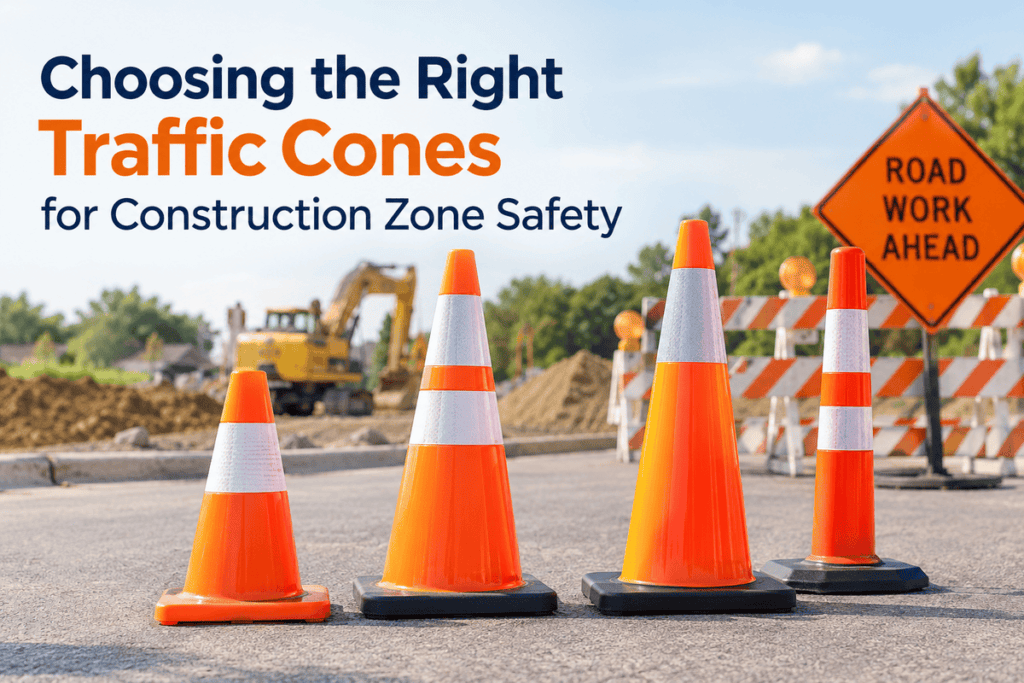
Eastern Highway’s current traffic cone range includes standard PVC cones in 300 mm, 450 mm, and 710 mm heights. Its range also includes larger cones with rubber bases at 710 mm, 730 mm, and 900 mm.
A small cone suit a controlled area where traffic speeds are low. A larger cone is more appropriate where drivers need greater visual awareness. The required size should ultimately match the project’s traffic-control plan and specifications.
2. Base Stability
A cone that tips over can stop providing the visual guidance it was placed there to give.
Base design becomes particularly important on exposed roads where wind, passing vehicles, or uneven surfaces can affect stability. Eastern Highway offers traffic safety cones with rubber bases in several sizes and weights, including a 710 mm cone with a 3 kg base, a 730 mm cone with a 4 kg base, and a 900 mm cone with a 4.5 kg base.
The right base depends on the working conditions. A heavier base can be useful where additional stability is needed, but the project specification should guide the final selection.
3. Reflective Visibility
A construction zone can remain active after sunset. Drivers still need to identify the temporary traffic path when natural light is low.
Reflective material helps a cone stand out when vehicle headlights reach it. These cones come with reflective bands. Another type in this category, known as Victor traffic safety barriers, uses reflective shields for nighttime visibility.
For projects that operate at night or have traffic moving through the work area after dark, reflective performance should be part of the product selection.
4. Material
Material affects how a cone handles regular movement and outdoor conditions.
Standard traffic safety cones are made of high-quality PVC. The available colours listed include yellow, red, white, blue, and green.
For road construction, the more important question is whether the selected cone meets the project’s required performance and specification. Contractors should avoid choosing a product solely because it is inexpensive.
5. Traffic and Road Conditions
A cone arrangement for an urban road might not be suitable for a major highway.
Consider the following before ordering:
- Traffic speed
- Traffic volume
- Number of lanes affected
- Daytime or nighttime work
- Road width
- Wind exposure
- Duration of the work
- Distance between workers and moving traffic
- Requirements in the approved traffic management plan
These details help to determine the appropriate cone size, base, visibility features, and quantity.
Choosing Cones for Highway Construction
Highway work zones require particular attention because vehicles may approach at higher speeds and have less time to respond to changes.
Cones can help create a visible line around a closed lane or guide vehicles through a temporary traffic path. NHA work-zone documents show cones being used alongside signs and other traffic-control measures rather than as a standalone safety device.
The layout matters just as much as the product. Drivers should be able to see a clear transition before reaching the area where normal traffic movement changes.
A project also requires additional equipment such as traffic barriers, delineator posts, warning signs, or temporary lighting. The choice depends on the nature of the work and the level of separation required.
Choosing Cones for Urban Road Work
Urban construction sites often have a mix of cars, motorcycles, buses, pedestrians, and commercial vehicles.
A road repair occupy only part of a lane, while utility work could affect the footpath and road at the same time. Cones can help make the work area easier to identify and guide traffic around it.
Their placement should also leave enough room for workers and equipment to operate safely. Where the work creates a greater physical hazard, cones alone may not provide sufficient separation. A suitable barrier or another protective system may be needed.
How Many Cones Does a Construction Site Need?
There is no single number that applies to every work zone.
The required quantity depends on the length and layout of the work area, traffic conditions, lane arrangement, and the approved traffic-control design.
Spacing can also vary. For example, an NHA work-zone drawing for a specific road configuration shows 1-metre-high retroreflective cones at 3-metre centres. Other projects can have different requirements. Contractors should therefore follow the project’s drawings, specifications, and instructions from the responsible engineer rather than applying one spacing rule to every site.
Do Cones Provide Enough Protection on Their Own?
Cones are mainly used to guide and delineate traffic. They are not a substitute for every type of physical protection.
A work area with workers or equipment close to moving traffic require additional protection. Traffic barriers can provide stronger separation, while warning signs can give drivers advance information about the upcoming change.
NHA documentation treats traffic diversion and work-zone safety as a broader traffic-management responsibility. Cones are one part of that arrangement.
The safety equipment should therefore match the actual hazard at the site.
Common Mistakes When Selecting Traffic Cones
Some problems are caused by choosing a product without considering how it will be used.
Common mistakes are as follow:
- Choosing a cone that is too small for the site conditions
- Using lightweight cones where greater stability is needed
- Ignoring nighttime visibility
- Mixing damaged or heavily worn cones into an active work zone
- Selecting products without checking project specifications
- Using cones where a physical barrier is required
- Treating cone spacing as a fixed rule for every road project
Regular checks are also important during active construction. Cones can be moved, knocked over, damaged, or displaced by traffic and weather.
Traffic Safety Cones for Construction Projects in Pakistan
Construction conditions vary across Pakistan. A motorway project has different traffic-control needs from an urban road repair or a development project inside a housing scheme.
Eastern Highway supplies ETEP Traffic Safety Cones as part of its road and traffic safety product range. Its current product information includes multiple cone sizes and rubber-base options. The company also supplies related products such as traffic barriers, delineator posts, safety signs, road studs, and other traffic safety equipment.
This makes it possible for contractors to consider cones alongside the other equipment needed for a temporary traffic-control setup.
How to Choose the Right Cone for Your Project
A practical selection process can be simple:
Start with the site. Look at traffic speed, road layout, work duration, and visibility conditions.
Check the project requirements. Review the approved drawings, specifications, and instructions from the relevant authority or engineer.
Choose the appropriate size. Consider the visibility needed at the location rather than automatically choosing the smallest or cheapest option.
Check stability. A suitable base is important where cones may be exposed to wind or passing traffic.
Consider nighttime work. Reflective features might be important when traffic passes through the work zone after dark.
Plan the complete setup. Add signs, barriers, delineators, lighting, or other equipment where the site requires them.
This approach helps contractors choose traffic cones based on actual site requirements instead of treating every construction zone in the same way.
Get Traffic Safety Cones for Your Project
The right traffic cone should fit the road, the traffic conditions, and the project’s safety requirements. A suitable product also needs to remain visible and stable throughout the work.
For traffic safety cones for construction zones, you can explore Eastern Highway’s Traffic Safety Cones and its wider range of traffic safety products.
Contractors planning a larger road or construction project can contact Eastern Highway to discuss the equipment required for the site.
FAQS
Are traffic cones suitable for temporary road closures?
Yes. Traffic safety cones are suitable for this purpose and are used to mark and guide traffic around a temporary closure. The required setup of traffic safety cones depends on the road layout and the level of restriction. Larger closures might require barriers, signs, and other traffic-control equipment.
Can traffic cones be used on motorways in Pakistan?
Traffic cones can only be part of motorway work-zone traffic control when they meet the requirements of the relevant project and road authority. Their use should follow the approved traffic-management arrangement rather than an informal layout.
What is the difference between a traffic cone and a delineator post?
A traffic cone is generally easy to move and is commonly used for temporary traffic control. A delineator post is a more rigid vertical marker used to guide road users and define road edges or temporary traffic paths.
How should damaged traffic cones be handled at a work site?
Damaged, badly faded, cracked, or unstable cones should be removed from active use and replaced or assessed. A damaged cone no longer provides the visibility or stability required for traffic control.
Can traffic cones be reused on different construction projects?
Yes, reusable cones can be moved between sites when they remain in suitable condition and meet the requirements of the new project. This can be done but inspection is necessary before deployment.