


Search “smart highway technology” and you’ll find a lot of coverage about self-driving cars talking to sensor-lined freeways in Singapore or Copenhagen. It’s an interesting picture of where global transportation research is headed — but it isn’t a picture of what’s actually being installed on Pakistan’s roads right now, and treating the two as the same thing does road authorities and contractors here a disservice.
On the ground, “smart” road infrastructure in Pakistan means something more immediate and more buildable: signage that reacts to real conditions, markings and reflectors that keep drivers safe after dark, and safety systems engineered for the country’s traffic volumes, terrain, and climate. This is the layer of smart infrastructure that’s already being installed on motorways, in housing societies, and on CPEC route corridors across the country — and it’s the foundation that any future AI-driven or connected-vehicle system would eventually have to sit on top of.
Table of Contents
ToggleWhat “Smart” Actually Means on Pakistani Highways Today
Before a road network can support autonomous vehicles or predictive AI traffic control, it needs a base layer of responsive, well-engineered physical infrastructure. That’s the stage most of Pakistan’s highway network is at — and it’s a meaningful stage, not a lesser one. The following categories represent the smart infrastructure that’s realistically being specified and installed on Pakistani roads today.
Variable Message Signs (VMS), LED & 3D Signage
VMS and LED signage let authorities push real-time information to drivers — diversions, weather warnings, speed advisories, incident alerts — without waiting for a physical sign change. On motorway and CPEC corridor projects, these digital sign systems are the closest equivalent to the “dynamic speed recommendation” concept in international smart-highway discussions, and they’re deployable now rather than years out.
Retroreflective & Thermoplastic Road Marking
A large share of nighttime accidents on Pakistani roads come down to poor lane visibility rather than any lack of connected technology. High-retroreflectivity paint and thermoplastic markings are a low-cost, high-impact way to make existing roads “read” more predictably to drivers after dark, and they’re a prerequisite for any future machine-vision or lane-keeping system that would need clean, high-contrast lane lines to function at all.
Cateyes & Road Studs for Low-Visibility Conditions
On hill routes, fog-prone corridors, and unlit rural stretches — common across northern Pakistan and CPEC alignments — reflective cateyes and road studs give drivers a continuous visual reference that paint alone can’t provide in poor weather. This is a simple, mechanical form of “always-on” road guidance, and it’s one of the most cost-effective smart-infrastructure upgrades available for terrain like Karakoram Highway or Hazara Motorway sections.
Driver Feedback & Speed Monitoring Signs
Driver feedback signs display a vehicle’s actual speed back to the driver in real time, prompting self-correction before enforcement is even needed. It’s a modest piece of technology, but it’s the same underlying principle as AI-driven speed advisory systems — real-time data changing driver behaviour on the spot — just implemented at a scale and cost that fits current infrastructure budgets.
Guard Rails, Barriers & Crash Cushion Systems
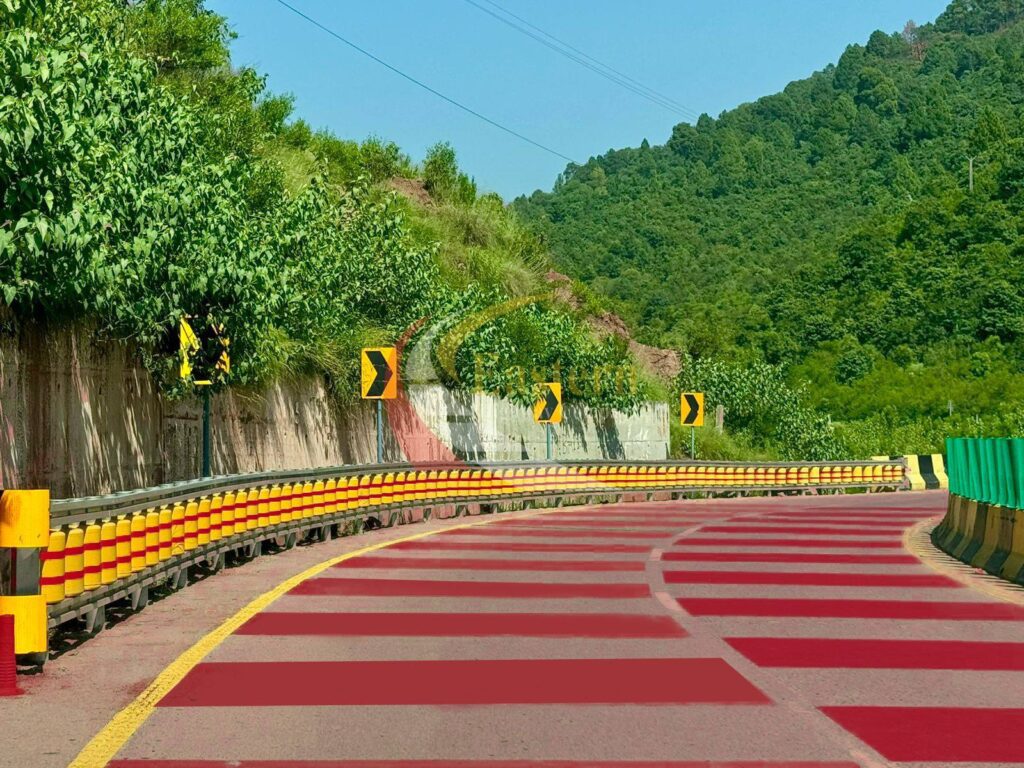
Engineered barrier and crash cushion systems don’t prevent every incident, but they change the outcome of the ones that do happen. As traffic volumes rise on urban highways and housing-society road networks, barrier placement is increasingly being treated as a data-informed decision — based on speed profiles, curve geometry, and incident history — rather than a one-size-fits-all specification.
See the current range of ETEP road safety products — signage, marking, barriers, and reflective systems built for Pakistani road conditions.
Why the Physical Layer Comes First
International smart-highway research is genuinely useful context — it shows where sensor networks, V2I communication, and predictive maintenance are eventually headed. But every one of those systems depends on a physical foundation: signs that are actually visible, markings that are actually reflective, and barriers that are actually rated for the traffic they’re protecting against. Skipping straight to advanced connected-vehicle concepts without that foundation is like discussing autopilot before the runway lights are installed.
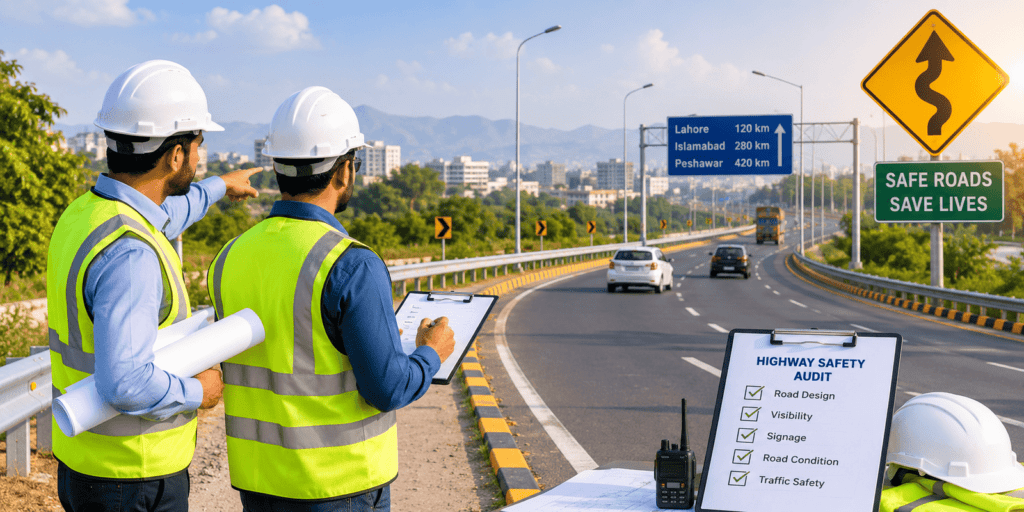
This is also why highway safety audits matter as a starting point for any “smart” upgrade plan — they identify where the existing physical layer is falling short before anyone spends on more advanced systems.
For a closer look at how that assessment process works, see our guide on highway safety audits in Pakistan.
Where This Is Already Happening
Eastern Highway Company has supplied road marking, signage, cateyes, and safety systems on motorway and CPEC projects including the Hazara Motorway (Thakot–Havelian), the Karakoram Highway, the Lahore–Sialkot Motorway, and the Multan–Sukkur Motorway, alongside housing-society and municipal projects for clients including NHA, FWO, NLC, Bahria Town, and DHA. These are the projects where “smart infrastructure” is being specified and installed today — not as a future concept, but as current scope of work.
Planning a highway, motorway, or housing-society road safety upgrade? Talk to Eastern Highway about signage, marking, and safety systems engineered for your project.
Frequently Asked Questions
Q1: Is AI-driven traffic technology being used on Pakistani roads yet?
Pilot-stage intelligent traffic signal and monitoring systems exist in some major cities, but the more consistent and widely deployed “smart” layer across Pakistan’s highway network today is physical: VMS/LED signage, retroreflective marking, driver feedback signs, and engineered barrier systems.
Q2: What’s the most cost-effective smart-infrastructure upgrade for a highway project?
Retroreflective and thermoplastic road marking typically delivers the largest nighttime safety improvement for the lowest cost, followed by cateyes/road studs on unlit or fog-prone sections and driver feedback signs at accident-prone points.
Q3: Do VMS and LED signs require ongoing maintenance?
Yes — like any electronic system, VMS and LED signage need periodic checks of power supply, display integrity, and mounting hardware, which is why they’re usually specified alongside a maintenance plan rather than as a one-time install.
Q4: How does a road authority decide where to start?
A structured highway safety audit is the standard starting point. It identifies which sections have the weakest visibility, marking, or barrier coverage, so upgrade budgets go to the highest-risk locations first rather than being spread evenly across a route.
Conclusion
Global smart-highway research points to an interesting long-term direction for road design — but for road authorities, contractors, and developers working in Pakistan today, the practical starting point is the physical layer: signage that communicates clearly, markings that stay visible after dark, and safety systems engineered for local traffic and terrain. That’s the smart infrastructure that’s actually being specified and installed on Pakistani highways right now, and it’s the foundation every future upgrade will be built on.