



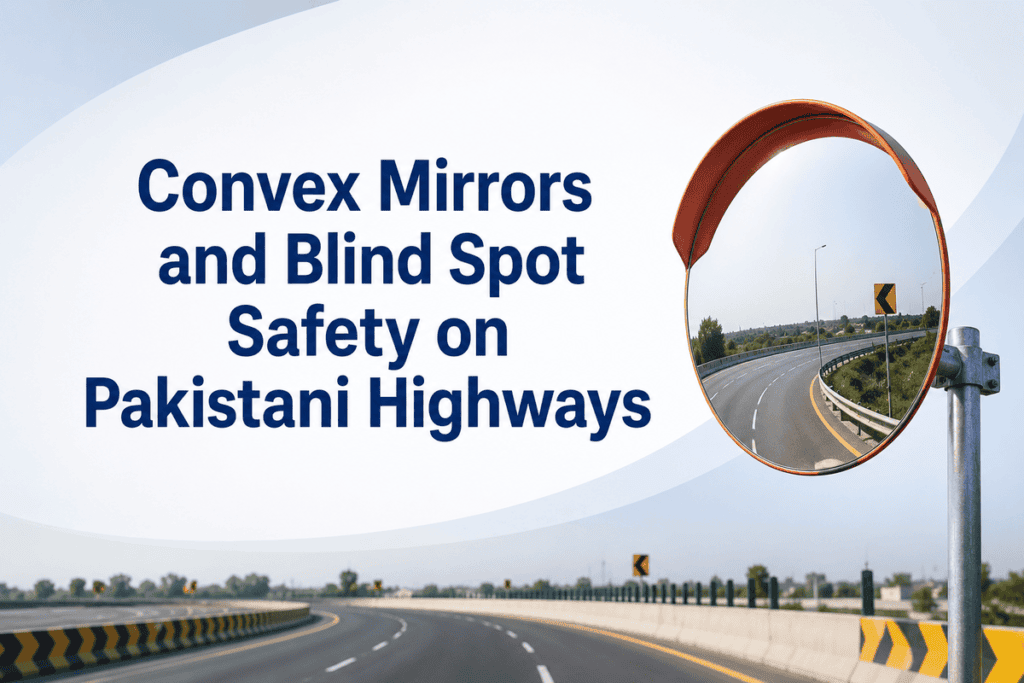
Sharp turns, hairpin bends, blind intersections, and vehicles emerging from hidden driveways can create serious visibility challenges on Pakistani highways. In these situations, standard flat mirrors may not provide drivers with a wide enough view of approaching traffic. Convex mirrors can improve visibility by providing a broader view around blind spots.
Convex mirror road safety projects in Pakistan use this simple and cost-effective solution at dangerous bends and other locations where limited visibility increases the risk of crashes. Convex mirrors also give an earlier view of vehicles approaching from hidden angles and reduce blind-spot risks.
Let’s explore this further to explain why convex mirrors are most useful and an important part of highway safety in Pakistan.
Table of Contents
ToggleThe Blind Spot Problem on Pakistani Roads
Road safety remains a serious public health challenge in Pakistan. Rescue 1122 recorded close to half a million road traffic incidents across Punjab in 2025, with nearly 4,800 deaths, a sharp rise from the year before. Motorcycles, which make up the bulk of Pakistan’s vehicle fleet, are involved in the majority of these crashes.
A large share of these accidents happen at points where drivers simply can’t see what’s coming. Sharp bends on hill roads, blind intersections in dense urban areas, and driveways or side roads merging onto main highways all create the same problem. A driver has no way to see oncoming traffic until it’s already too close to react safely.
This is exactly where a convex mirror earns its place. It doesn’t stop a vehicle from being in a blind spot. It gives the driver a way to see around it.
How Convex Mirrors Solve the Problem
A convex mirror curves outward, which spreads light across a wider field of view than a flat mirror ever could. The trade-off is that objects appear smaller than they really are, but that small distortion buys a much bigger picture of the road ahead.
Installed at the right spot, a convex mirror lets a driver see:
- Oncoming traffic before pulling out of a blind driveway or side street
- Vehicles approaching from around a sharp bend or hairpin turn
- Pedestrians or motorcycles hidden by parked vehicles or roadside structures
- Cross traffic at intersections with limited visibility in one direction
None of this needs electricity, wiring, or ongoing maintenance. A properly mounted convex mirror works around the clock, in any weather, for years after installation.
Where Convex Mirrors Are Needed the Most in Pakistan
- Mountain and hill roads – Routes through northern Pakistan are known for tight hairpin bends with almost no visibility around the curve. A convex mirror placed at the right angle gives drivers a few extra seconds of warning before a vehicle comes around the corner.
- Urban intersections – Dense city traffic, combined with buildings or walls close to the road, often blocks the view at smaller intersections. Motorcycles, which move faster and are harder to spot than cars, are especially vulnerable here.
- Highway merge points and driveways – Vehicles pulling onto national highways from side roads or private driveways face a similar risk. A blind spot at the point of merging is one of the most common setups for a serious collision.
- Toll plazas and checkpoints – Security and toll staff often need to see around large vehicles without leaving their post. A well-placed convex mirror gives them that view instantly.
Choosing the Right Convex Mirror
Not every convex mirror suits every location. A few factors decide what works best for a given site.
Material
Acrylic and polycarbonate mirrors are common choices for outdoor road use. Polycarbonate versions tend to hold up well against impact and rough weather, which matters on exposed highway stretches.
Size
Larger mirrors cover a wider area and suit high-speed roads, where drivers need more advance warning. Smaller mirrors work fine for tighter urban corners or driveways.
Mounting
A stable pole or wall mount matters as much as the mirror itself. A mirror that shakes or shifts in strong wind loses much of its value.
Weather resistance
Roads exposed to intense sun, heavy rain, or dust need mirrors built to resist fading, cracking, or clouding over time.
Our ETEP convex mirrors are built from durable polycarbonate material designed for exactly this kind of outdoor, high-traffic use, giving drivers and pedestrians a clear, distortion-free view at blind spots across Pakistan’s road network.
Convex Mirrors as Part of a Bigger Safety Plan
A convex mirror works best as part of a wider road safety strategy rather than as a stand-alone solution. Reflective road studs, clear warning signs, speed breakers, barricades, road markings, and adequate lighting can work together to reduce accident risks at high-risk locations. For example, a convex mirror placed near a sharp blind bend, along with a warning sign, gives drivers an early visual cue to slow down and watch for approaching traffic.
Local authorities, road management agencies, and private site managers all have a role in identifying locations where visibility is limited. Installing a convex mirror at a dangerous driveway, intersection, or bend is a relatively simple investment that can improve driver awareness and help prevent potentially serious collisions. As part of convex mirror road safety projects in Pakistan, these measures can support safer movement on busy highways and local roads.
Installing Convex Mirrors the Right Way
Getting the placement right matters as much as choosing the right mirror. A few basics worth following:
- Install the mirror where it directly faces the blind spot or oncoming traffic path
- Set the height so it’s visible to both car and motorcycle riders
- Angle the mirror to minimize glare from direct sunlight during peak driving hours
- Check the mounting regularly, especially after storms or high winds
- Pair the mirror with a warning sign where the blind spot is especially dangerous
A poorly angled mirror gives a false sense of safety, which can be worse than having no mirror at all. Getting the installation right the first time makes a real difference.
Final Thoughts
Blind spots aren’t going away on their own, especially on Pakistan’s mix of hill roads, dense urban streets, and fast-moving highways. A convex mirror is one of the simplest, most reliable tools available for closing that visibility gap, and it keeps working for years with no power source and almost no upkeep.
If you’re planning road safety upgrades for a highway stretch, intersection, or private site, our team can help you choose the right convex mirror for the location. You can also read more about how these mirrors are used across different settings in our guide to uses of convex mirror.
FAQs
Do convex mirrors need any power source?
No. Convex mirrors are entirely passive, using curved reflective material rather than electronics, which means they work without wiring or maintenance.
How long do outdoor convex mirrors typically last?
A quality polycarbonate or acrylic convex mirror, properly mounted, can last for several years even under constant sun and rain exposure.
Can convex mirrors replace traffic signs at dangerous bends?
No. Mirrors improve visibility, but they work best alongside signage, not as a replacement for it.
Are convex mirrors effective for motorcycle safety specifically?
Yes. Motorcycles are smaller and harder to spot than cars, a convex mirror at a blind intersection or bend gives extra reaction time that benefits motorcyclists in particular.
Where should a convex mirror be placed for the best results?
It should directly face the blind spot or oncoming traffic path, mounted at a height and angle visible to all types of vehicles passing through.