




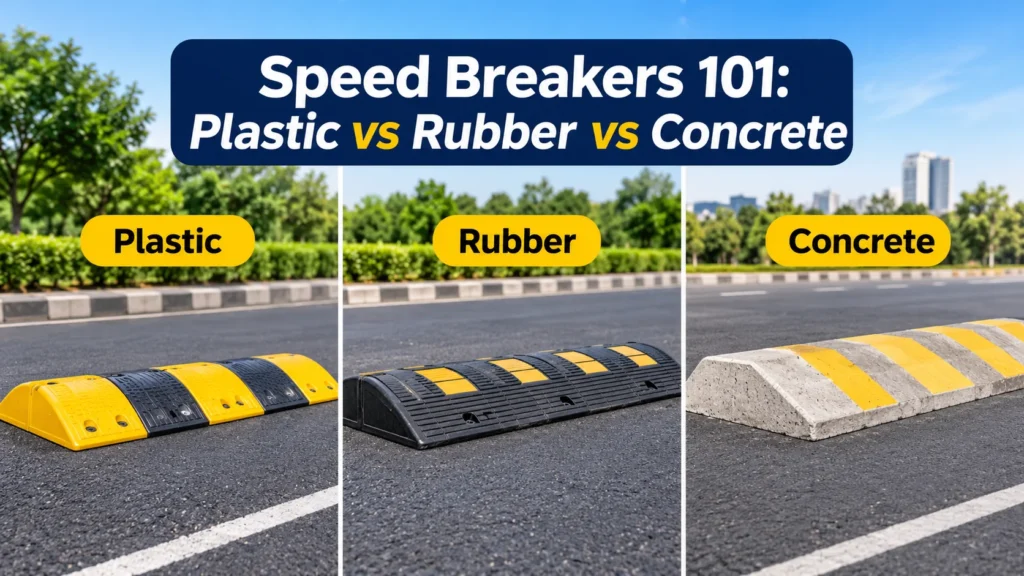
Speed breakers help control vehicle speed in residential streets, parking areas, school zones, and other locations where slower traffic is necessary. However, the material used to make them affects their installation, durability, maintenance, and overall performance.
The three common options are plastic, rubber, and concrete speed breakers. Each has different advantages and limitations. Understanding these differences helps contractors, road authorities and property managers choose the right solution for their requirements.
Here is how plastic, rubber, and concrete speed breakers compare in Pakistan.
Table of Contents
Toggle1. Plastic Speed Breakers
Plastic speed breakers are lightweight, modular units designed to control vehicle speed. They are generally installed in sections and secured to the road surface with suitable fixing hardware.
Advantages
- Lightweight and easy to transport.
- Quick installation without major road construction.
- Modular design allows damaged sections to be replaced.
- Suitable for parking areas, private roads, and residential streets.
- Available with reflective features for better nighttime visibility.
Limitations
Plastic speed breakers require proper anchoring and a suitable installation surface. Their performance depends on material quality, fixing methods and traffic conditions.
Best applications
- Parking areas
- Housing societies
- Commercial premises
- Private roads
- Controlled-access locations
You can explore ETEP plastic speed breakers to learn more about their features and specifications.
2. Rubber Speed Breakers
Rubber speed breakers are commonly made from durable rubber compounds. They are available in modular sections and can be installed on suitable road surfaces using bolts or other recommended fixing methods.
Advantages
- Flexible construction helps absorb vehicle impact.
- Modular sections allow easier replacement.
- Relatively simple installation.
- Suitable for parking facilities and low-speed traffic areas.
- Reflective strips can improve nighttime visibility.
Limitations
Rubber can deteriorate with prolonged exposure to sunlight, heat, and heavy traffic. Its service life depends on rubber quality, installation, and maintenance.
Applications
- Parking lots
- Residential streets
- Industrial premises
- Private access roads
Read more about rubber speed breakers and their common applications.
3. Concrete Speed Breakers
Concrete speed breakers are fixed structures built directly on the road surface. They are generally constructed using concrete and shaped according to the required design.
Advantages
- Strong and suitable for permanent installations.
- Can withstand regular vehicle traffic when properly designed.
- Do not require modular fixing hardware.
- Can be integrated into the existing road surface.
Limitations
Concrete speed breakers require construction work, proper curing, and more installation time. Repairs can also involve breaking and rebuilding damaged sections. Their fixed nature makes removal or relocation difficult.
Applications
Selected permanent road installations where the design, location, and construction requirements have been approved.
Plastic vs Rubber vs Concrete Speed Breakers: Key Differences
The following table highlights the main differences between these three materials.
Feature | Plastic | Rubber | Concrete |
|---|---|---|---|
Installation | Quick | Quick | Requires construction |
Weight | Lightweight | Moderate | Heavy |
Flexibility | Limited | Higher | Rigid |
Maintenance | Section replacement | Section replacement | Repair or reconstruction |
Relocation | Relatively easy | Relatively easy | Difficult |
Construction work | Minimal | Minimal | Required |
Best suited for | Parking and private roads | Low-speed access areas | Permanent installations |
No single material is suitable for every location. The right choice depends on traffic volume, road conditions, installation requirements, and available maintenance resources.
Which Speed Breaker Is Best for Roads in Pakistan?
The best speed breaker depends on where it will be installed and how the area is used. Plastic speed breakers are a practical option for locations that need quick installation and easier replacement. They are particularly useful in parking areas, housing societies and commercial premises.
Rubber speed breakers offer flexibility and modular installation. They are suitable for areas where controlled traffic movement is required without permanent road construction.
Concrete speed breakers are more appropriate for approved permanent installations where relocation is not expected.
Before selecting any option, consider the following factors:
- Traffic volume: Check how frequently cars, motorcycles, and heavy vehicles use the road.
- Road surface: Ensure the material and fixing method suit the pavement.
- Installation requirements: Consider whether the location needs a temporary, removable or permanent solution.
- Visibility: Choose suitable reflective features for nighttime traffic, such as cateyes and road studs alongside the speed breaker.
- Maintenance: Assess the availability and cost of future repairs or replacement.
- Budget: Compare the initial purchase price with installation and long-term maintenance costs.
Speed breakers should also be installed at suitable locations and follow approved design requirements. The Capital Development Authority’s Islamabad policy identifies local and collector streets with lower vehicle speeds as suitable locations and advises against placing speed breakers on major roads and primary emergency response routes. For larger projects, a highway safety audit can help confirm that the location and design are suitable.
Speed breakers also work best when drivers get a clear warning ahead of them. Driver feedback signs can remind drivers to slow down, and convex mirrors help at blind spots and intersections. Where an audible warning is needed on approach, rumble strips are another option.
Where Are Different Types of Speed Breakers Used?
Different locations have different traffic control requirements.
- Housing societies: Plastic and rubber speed breakers can help control vehicle movement on internal roads.
- Parking areas: Modular speed breakers help manage vehicle speeds near entrances, exits and pedestrian areas.
- Schools and hospitals: Properly designed speed control measures can help protect pedestrians near busy access points.
- Industrial facilities: Rubber and plastic options can help manage vehicle movement within premises.
- Permanent road installations: Concrete structures may be considered where approved designs and construction requirements support their use.
For more information, explore the different types of speed breakers available for roads, parking areas and private premises. Property managers can also see the full range of parking products.
Final Thoughts
Plastic, rubber, and concrete speed breakers each serve different purposes. Plastic offers lightweight construction and convenient installation. Rubber provides flexibility and modular replacement. Concrete offers a fixed solution for suitable permanent installations.
The right choice depends on the location, traffic conditions, installation requirements, and maintenance budget.
Eastern Highway offers plastic, rubber, and aluminium speed breaker options for different traffic management needs in Pakistan. Explore its range of speed breakers or contact the team to discuss the right option for your project.
Frequently Asked Questions
1. Which speed breaker is better, plastic or rubber?
Both are suitable for different applications. Plastic offers lightweight construction, while rubber provides greater flexibility.
2. Are concrete speed breakers permanent?
Yes. Concrete speed breakers are fixed structures and generally require construction work for removal or relocation.
3. Where are plastic speed breakers commonly used?
They are commonly installed in parking areas, housing societies, commercial premises and private roads.
4. Do rubber speed breakers require maintenance?
Yes. Regular checks help identify loose fixings, damaged sections and worn reflective strips.
5. Which speed breaker is suitable for parking areas?
Plastic and rubber speed breakers are both practical options for parking areas, depending on traffic conditions and installation requirements.